

Vibe Coding is Rewriting Digital Services: What Agencies, SaaS, and Marketers Must Do Next
Why this Shift Feels Sudden, Even Though It Has Started Since Years Ago
Since more than four years ago, building anything that’s digital followed a familiar rhythm. Business Development / Client Servicing or Accounts teams had to sit down to work out the brief, idea, design and tech specifics with Project Managers, alongside Creative Directors, Art Directors, or Graphic Designers, or UX/UI Designers, designated Developers and not forgetting interns. The project scope was also subjective, as it was dependent on variables (if creative teams, art teams, copywriting teams, tech teams, etc., are required based on the weightage of work expected) like if its a tech-heavy CMS website, or an interactive-and-creative-intensive campaign website, and so much more. All of these came in branches leading to varied business cost models and overhead infrastructures per project.
Creative and Art Directors had to brainstorm on many ideas to form conceptual and mood boards that led to a few big ideas and then shortlist for an effective and a big campaign idea that actually makes sense, not just in aesthetic and the theatrical aspect of it. It actually goes beyond that with a PR / Marketing campaign and so forth. If there was no abstract, revenue-recurring streams or design thinking involved, the big idea may not cut through that easily, and the campaign could either turn out to be mediocre or fail at the expense of it.
The process was intensive:
- Designers created static visual mock-ups (you can imagine concept and mood boards, brand identity like a “font and logo library and colour psychology wiki”, storyboarding, etc.), and then move onto interactive UX/UI mockups (if the client is a very “visual-type”).
- Developers then translated those design elements (now, we have Canva, etc.) and layouts into code (now, we have Figma, etc.). Backend engineers stitched systems together (now, we have Lovable, Replit, Bolt, etc.).
- DevOps teams deployed and maintained infrastructure (now, we have Digital Ocean, Cloudflare Workers, Supabase, Azure, Docker, etc.).
- Security teams set perimeter-focused IT protection to comprehensive digital asset management, network protection, antivirus, managing the initial rise of web-based threats (phishing, malware, trojan horse, etc.), and to cloud app security, mobile device security, advanced ransomware protection, and strict data privacy compliance (GDPR/PDPA) – now, we have Crowdstrike, Aikido Security, Applitools, etc.
- Public Relations, Marketing and Communications teams arrived later to integrate and plan the launch of what is going to be built (now, we have GenAI platforms and AI Agents to help you with that but would require extensive human oversight, proofreading, editing and more: Make.com, ElevenLabs, Creatify.ai, etc.).

Pardon me as I need to digress a little (ranting season just came).
This is something that I have been wanting to rant out about people who have been misleading information and shaping what is exactly not true when speaking to the public about AI taking over PR, Marketing and Communications roles. These people are either ignorant, naive and obviously have no idea what they are talking about because they are not in PR, Marketing, Sales and Communications roles. In my recent experience at a worldwide conference held in Singapore, someone mistook and shared that AI is taking over marketing and sales roles. If that is true, please tell me where exactly and what it can actually do to achieve a professional-grade and/or an enterprise-grade quality of outputs in PR, Marketing and Communications? If that person was specific about which entry-level-admin work type, that was fine as it is true. What in the world was that? 🤬
⚠️ So here’s a final warning to industry leaders in Singapore: Be careful what you say in public about what roles AI can take over. Please do your effing homework before you affirm and say such things to embarrass yourselves in public conferences. 🤦🏼♀️
We were schooled, trained and experienced being a part of the intensive process that held a fixed timeline, which meant it looked slow from the outside. However, it was actually time-consuming because coordination used to be very expensive and the work was mostly done by humans manually on purchased license software.
What we are watching now feels abrupt, and for many teams it feels personal. In a single year, the gap between “idea” and “a working MVP” has collapsed. We can’t blame startups moving faster, nor clients asking harder questions, procurement pushing back on old timelines, and buyers realising they can test alternatives without committing to a six-month statement of work papers.
Vibe coding did not arrive overnight. It emerged from converging forces: mature cloud infrastructure, standardised APIs, advanced systems, and then a big step change in generative AI capability. The final outcome is what really matters now, like a vision of a prototype coming out alive. Instead of in PowerPoint slides or thick decks. Whether it is a mobile application, a one-landing page website, a CMS website with deployment-ready stacks for integration, or a campaign portal. In fact, creation has become much cheaper, faster, and more accessible than ever before.
But the part most people miss is this: when creation becomes abundant, trust becomes scarce.
That is why this shift is rewriting core digital services. Not because agencies, SaaS companies, or marketing firms are suddenly irrelevant. It is because the market is recalculating what it is actually paying for.
Why This Acceleration Is Happening Now
Up till 2025, earlier generations of AI-assisted development were fragile. They produced brittle outputs, required heavy clean-up, and did not integrate cleanly into production systems. They were useful for explorations and experiments in sandboxes, however, they were never meant to be translated into real business processes that comes with a huge bag of compliance, risk performance, and reputational constraints. What changed is the constant model capability upgrade that mirrors the environment design, hence the steep and extremely competitive AI engineering landscape.
AI is no longer bolted onto workflows as an afterthought. It is embedded directly inside production, staging and preview environments where design, logic, and deployment sit side by side. That shortens feedback loops dramatically. Instead of handing work from one team to another and waiting for days of replies on translation, creators can iterate and collaborate in real time.
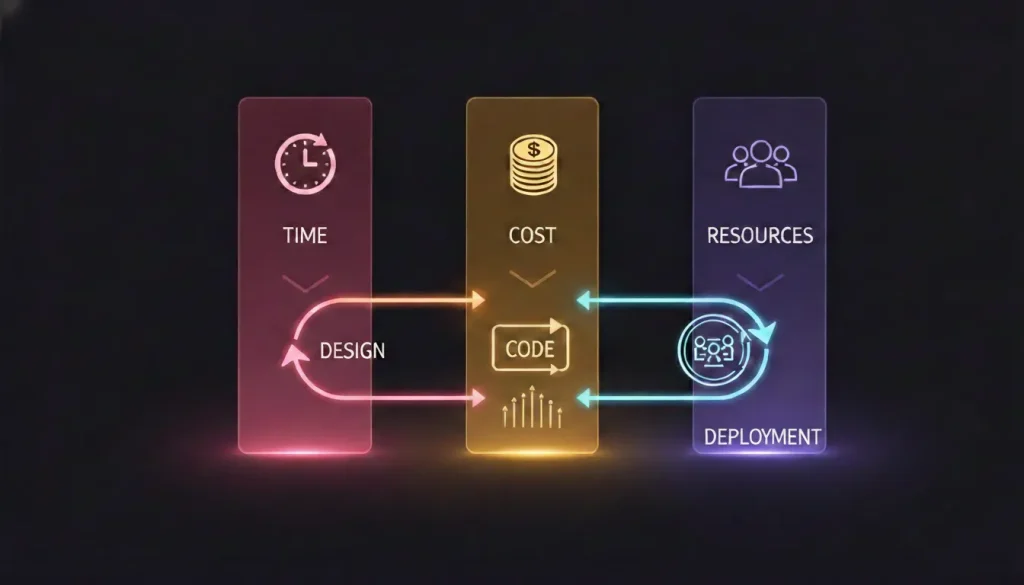
This brings back to where work processes encapsulate “time vs cost vs resource” compression as the real disruption.
- Time compresses
- Cost compresses
- Resource reduces
- The distance between intention and implementation collapses
This compression changes pricing, staffing, and buyer expectations. It also changes risk because when people can package projects to ship faster, they can also ship out mistakes faster.
What Vibe Coding Means in a Professional Context
Vibe coding is often misunderstood because the term sounds informal and experimental. In reality, it describes a specific behaviour that is already reshaping the AI startups and their professional delivery.
At its core, vibe coding is intent-led creation based on prompt engineering.
A human defines the:
- Objective
- Instructions
- Constraints
- Outputs
AI accelerates:
- Execution
- Iteration
- Integration
While we’re at it, I must tell you this. This is not “tell an AI to build me an app and hope it works.”
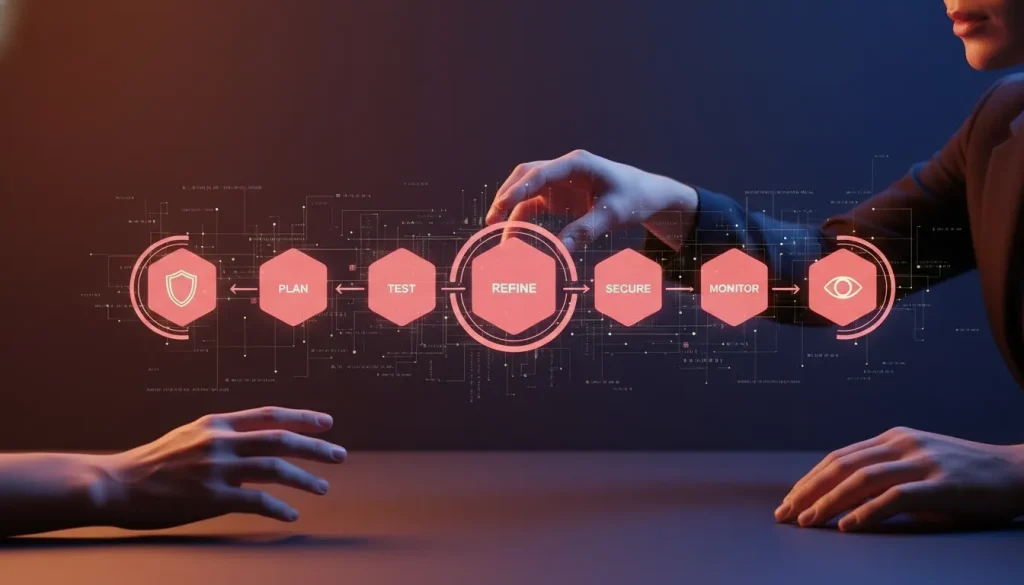
In professional settings, vibe coding is a continuous loop:
- generate plan
- test in sandbox
- apply agile methodology
- refine the framework
- secure the architecture
- export the system
- package the files
- ship out to deploy
- test the market
- go-to-market
The human remains accountable for decisions, trade-offs, and outcomes. While this is not optional, it is prudent that professional services do not gamify away responsibility. Vibe coding makes it impossible to pretend otherwise.
The AI Platforms that are Quietly Changing What “Building” Means
If you remember what I have mentioned above, “We can’t blame startups moving faster, nor clients asking harder questions, procurement pushing back on old timelines, and buyers realising they can test alternatives without committing to a six-month statement of work papers.” The evolving digital and AI ecosystem effect influences on new and upcoming tools to converge into workflows and integrate into deployment stacks, in the hopes of anchoring specific industries to use them, and then collapsing human roles.
Figma Make is pushing design closer to production logic, blurring the boundary between visual thinking and functional systems. Replit enables collaboration and cloud-native development with AI assistance woven directly into the coding environment. Lovable focuses on rapid generation of web apps and systems designed to evolve rather than remain static. Bolt enables end-to-end website and application creation with AI-assisted build and deployment, dramatically reducing turnaround time for common digital builds.
And Manus represents another important evolution. Rather than assisting with isolated tasks, it operates as an agentic system capable of executing multi-step workflows autonomously, reflecting a broader industry move towards AI that can act, not just suggest.
If you ask me:
In economies of scale, this is downsizing the workforce at scale.
Some would say this is a “strategic downsizing”, but in this AI era where Agentic AI is picking up its pace, I would say this:
The average cost of developing, deploying, and running an AI application decreases as the volume of usage, data, or compute power increases.
Thus, this conveys and translates to what the world is grappling and struggling with:
The green economy buzz…hmm…
Let’s take a look at our green economy plan.
Okay, I shall not digress this time around.
In practical terms, modern AI builders are combining:
- design-first environments that move closer to building MVPs and working prototypes
- AI-assisted coding environments that move closer to deployment
- backend services that move closer to plug and play configurations
- infra layers that move closer to one-click production setups
Here’s a sample of a business landing page I’d managed to pull out of Lovable in less than 1 1/2 days.

This is why modular stacks have become normal: a frontend, a managed backend, a deployment layer, and integrations that snap into place (like setting up your IKEA furniture or a SecretLab chair). Therefore, this is also why the economics of delivery have shifted. You are not always paying for code development anymore, as the blurred lines cross over to site architecture, security, governance, while making precise decisions at a different phase and time. One thing’s for sure, when a little piece of the puzzle goes missing (e.g., a code library component, tech stack component, environment variables, incomplete code framework structure, etc.), you will be back at the crossroad when your setup was functioning at 100 percent with no bugs, before the iteration or cyclical phases. This is a given thing that vibe coders have had to endure. To add, non-coders may have to spend more credits to fulfill certain coding improvements as compared to expert coders and mid-range experienced coders.
From Deliverables to Modular Systems
Digital work is no longer delivered as a finished artefact that gets handed over and be forgotten. Increasingly, it is delivered as a modular system that evolves as AI-assistant models upgrade.
Modern builds often rely on composite architectures:
- frontends that connect to managed backends
- containerisation for portability and testing
- cloud deployment platforms that remove ops overhead
- APIs that reduce tight coupling
This changes expectations on both ends.
Clients may no longer expect perfection at launch. They’d expect adaptability, quick changes as the system grows, easily reconfigured, and be connected to whatever comes next.
For service providers, value is no longer tied to one delivery moment. It is tied to whether the system can evolve without falling apart.
What Can Be Built Today That Once Required An Entire Human Team
This is where the market reaction is most emotional.
It is now possible for small teams, and sometimes individuals to build:
- business websites and landing pages
- internal dashboards and campaign portals
- web / mobile applications and prototypes that feel like real digital products
- marketing automation layers and integrated digitalisation stacks
- campaign assets at scale and translated across various media formats
This proves that the “future of work” can become trivial, while the development environment plate shifts.
As coordination becomes cheaper, iteration multiplies faster, and the cost of experimentation drops.
This is why agencies are under pressure.
The Pressure Point of Why Agencies Feel This First
For decades, agencies historically built pricing models around time, scarcity, and complexity.
Projects can develop over several months because coordination and integration of human development services stretches across the timelines. Costs were justified by the number of people involved, the approvals required, and the hours needed to align everyone.
To put in simple and plain English: Vibe coding compresses those assumptions and reduces ambiguity.
Vibe coding relies on continuous feedback loops where outputs are reviewed, adjusted, and guided until they are fit for a purpose.
When a functional web application can be prototyped in days, clients question timelines and fees. When integrations can be configured rather than custom built, they question why every project still feels bespoke.
This does not mean agencies do not have a future. They have to evolve into a powerhouse of AI prompt engineers and impressive Generative AI creators, whereby execution alone is a sought-after skills equipped with core values.
The agencies that survive this shift will be the ones that sell:
- Problem framing
- Roadmap prioritisation
- System architecture
- Governance and security
- Measurable outcomes
What This Means for SaaS Companies
SaaS will not die just to relive another day. The real question is whether your SaaS product is a tool, or whether it is a workflow the buyer can trust to scale company growth.
Buyers are increasingly evaluating:
- What the market or industry thinks of your product
- How the product fits into their existing systems
- Whether it supports governance and compliance
- Whether it reduces operational load
- Whether it can be adopted without months of change management
Vibe coding does not bury SaaS alive, as it raises the bar for top notch enterprise-quality SaaS.
If teams can assemble alternatives quickly, your product must justify itself with trust, reliability, and business outcomes.
What This Means for Marketing Firms
Marketers are not being replaced. But the economics of production have changed so much that the market is now asking a different question.
It skews towards, “Can you create?”, but “Can you also drive growth and revenue outcomes?”
As AI lowers the barrier to producing lower-grade-quality content, assets, campaigns and presentation slides, scrutiny shifts to:
- Conversion quality
- Trust signals
- Brand consistency
- Measurement discipline
- Audience relevance
These parts contribute and constitute how Marketing is elevated with a fresh perspective.
If everyone can create, the marketer who wins is the one who can orchestrate an AI system that performs and delivers.
Where Human Expertise Becomes More Valuable
There are responsibilities that remain firmly human:
- Problem framing and prioritisation
- Behavioural understanding
- Contextual and nuanced writing
- Trade-offs, risk management, and consequence mapping
- Compliance and ethical judgement
- Stakeholder alignment and change management
AI agents can propose options and take actions but it cannot own consequences. This is where it complicates how humans are supposed to handle such matters.
Thus, this is why professional services are here to stay to be relevant, as they are being enforced to become more transparent about what they actually sell, are certified for and so forth.

How Vibe Coding Put the Creator Economy on a Pedestal
This compression of time and cost did not just disrupt agencies and digital marketing firms. It rewired the creator economy.
When creation becomes faster and more accessible, outputs and decentralised distribution hubs become a sea of battlegrounds.
AI builders and creators who show how tools are used in real time have gained traction on YouTube, TikTok, Instagram, LinkedIn, and Facebook. Recommendation algorithms are increasingly pushing these feeds to non-followers, converting passive viewers into followers and customers.
The platforms do not reward technical depth alone. In fact, they reward clarity, confidence, and narrative momentum.
Vibe coding has turned creators into translators, and these translators shape adoption among the masses who are on these social media platforms.
From Spectacle to Systems and Why MrBeast’s Evolution Matters Today to the Younger Generations
This creator-driven shift reinforces the same structural pressure facing professional services. When audiences learn directly from content creators who are AI builders, and practitioners in public social content, authority becomes grounded and distributed. Agencies, SaaS companies, and marketing firms can no longer rely solely on credentials, polished decks, or sponsored content. They are competing, whether they realise it or not with real-time YouTube, Instagram and TikTok demonstrations, open experimentation, and narrative transparencies. B2B and B2C industries are no longer segregated like before. Both are already merging into a narrow lane of competition.
This pattern mirrors what we have seen in MrBeast’s recent content arc.
He built an audience on spectacle, but his newer content increasingly leans into systems and “how things work.” His recent SpaceX visit, where he spoke with a SpaceX Vice President and explored how rockets are built to withstand extreme conditions, is a good example of how engineering becomes mainstream when someone translates it into a story people can follow (especially to the younger generations).
“I even saw people cross-promoting MrBeast’s SpaceX episode on LinkedIn from one of the top publishers with high authority, a digital magazine.”
This matters because it reflects the same dynamics of today’s content creators who are driving AI adoption towards their followers and subscribers. Social media users trust what they can understand, and what they can see in real life as being tested, like a social proof point without the testimonial.
Vibe coding has led the way for how everyday humans can build anything through a chain of prompts. It also changed which content creators people trust to explain how things actually work and how to execute it. That trust increasingly flows to those who combine technical capability with storytelling fluency. And that is the deeper disruption many organisations are still struggling to compete with based on larger followers’ base.

The Quiet Shift No One Budgeted For
For years, digital services were expensive because there were not many of them, whereby talents with skills were siloed and scattered across specialised teams. Aside from that, accessible tools were fragmented that led to monthly and annual subscription burns, and signalling the lack of accreditations.
However, vibe coding has made it possible to move from idea to implementation without assembling a traditional agency or a tech company. It is already affecting website development, UX and UI, integration work, marketing operations, analytics setup, and internal tools.
This time around while creation has become cheaper, friction of adoption remains lower due to accessibility and cheaper annual subscriptions, thus, flipping the entire script that anything is possible (by sacrificing more computing power and credits), even for non technical users and non coders. The blurred lines are drifting apart more than ever, and technical barriers are collapsing. However, digital trust has not followed at the same speed because SaaS startups and companies would require multiplied secure guardrails and enterprise-grade security certifications. Like the ISOCert, SOC, SOC2, Cyber Safe, HIPAA, and so forth.
The Security Reality Check, When Vibe-Coded Apps Go Public

Here is the part many app builders, and many clients still unconsciously weigh security and governance to compromise cheaper deliverables.
If they can ship fast, they are also exposed to several factors that can influence and affect them, such as revealing vulnerabilities and unsecured infrastructure layers fast.
A fresh example is the Moltbook ecosystem, a new social network designed for AI agents, which quickly drew attention for both novelty and risk. Several legitimate news and social media reporting described it as a Reddit-style platform for AI agents, and it claimed over 1.5 million registered agents.
Then, the security story landed with a bang.
Security analysis reported that researchers at Wiz found an exposed API key that provided read and write access to Moltbook’s production database with exposure including large volumes of API authentication tokens, email addresses, and private messages.
Separate analysis described malicious activity by bots, including prompt injection attempts between agents, plus risks emerging from an associated skills marketplace where harmful capabilities could be distributed.
While the OpenClaw (formerly called Moltbot and Clawdbot) owner and creator mentioned that he built the app with his vision, not with code hardening and built-in security guardrails, this issue shed another angle at what these thousands of AI vibe-coding startups are trying to achieve.
This is the moral story that the public has asked for. If vibe coders chose to publish their public-facing apps without proper security architecture, governance, and industry-standard controls, the product can become a liability faster than it becomes a business. Rapid app building and creation does not excuse weak security. Indeed, it can magically magnify nuclear-blast backlash from community spaces, which is going to be hard to come back unless these people are doing it for fun sake.
What “Proper Security Architecture” Means for Small Teams
This is where many creators and small teams get stuck. They hear “security,” and they assume it means enterprise budgets.
No.
It means disciplined basics that are implemented early:
- Secrets management and key hygiene No keys in client-side code, repos, logs, or screenshots. Rotate keys, and restrict scopes.
- Access control and least privilege Role-based access for production systems, and separate environments for dev, staging, and prod.
- Audit logs and monitoring If something goes wrong, you need traceability.
- Threat modelling for agent workflows Agentic systems expand attack surfaces. If agents can message each other, read tools, or trigger actions, you must treat prompts as untrusted input.
- Data minimisation and privacy-by-design Collect only what you need. Keep retention policies. Encrypt sensitive data at rest and in transit.
- Clear governance for third party skills, plugins, and integrations Marketplaces and plug-ins can become supply chain risk multipliers.
If you treat vibe coding as your co-builder, then packaging it with security discipline makes sense.
What Must Agencies, SaaS, and Marketers Do Next?
This is the practical pivot.
1) Agencies must move from “delivery teams” to “decision teams”
If your pitch is execution capacity, you will be commoditised. If your pitch is risk-aware outcome delivery, you stay relevant.
What to change:
- sell discovery, prioritisation, and governance as core
- productise audits, architecture, and measurement systems
- build modular delivery frameworks, not one-off projects
2) SaaS companies must own workflows, not features
Features are easy to copy. Trusted workflows are hard to replace.
What to change:
- focus on integration readiness
- make governance and compliance a competitive edge
- reduce buyer effort, and increase adoption clarity
3) Marketers must become system orchestrators
Production is cheap. Outcomes are not.
What to change:
- tie assets to measurable lift
- build trust signals beyond search visibility
- prove impact with clean measurement, not vanity metrics

My Personal Anecdote
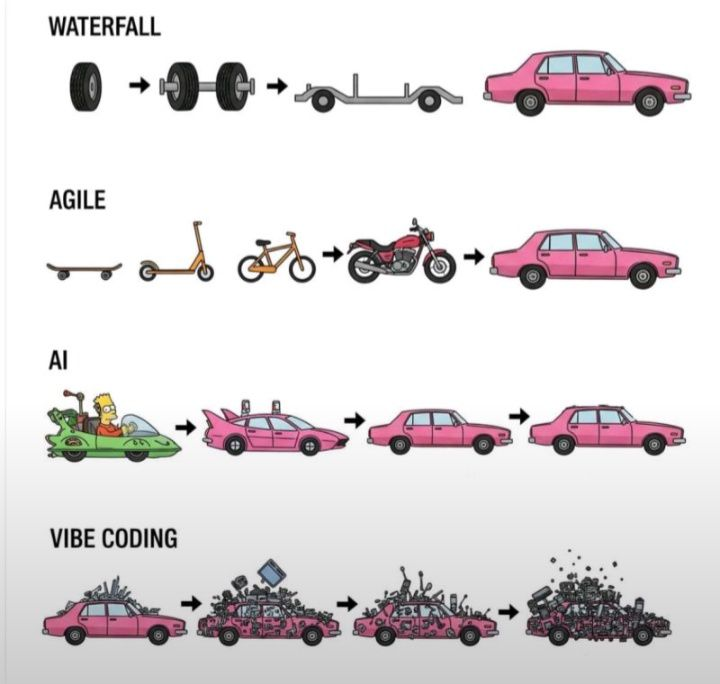
A moment in awe and a reflection on hardships brought me back to where we sat across a client who was quoted close to six figures for a mobile application, and tens of thousands for a full website build. Realising how much of the cost was fixated on billable hours of skills and humanised coordination, planning, outsourcing, resource management, user acceptance testing, application deployment, and translation. And then seeing now, how vibe-coding workflows have allowed several businesses to reduce costs, while raising the stakes on responsibility, accountability and security. Exciting times are here, and here’s a dev. joke meme that appeared last year. IYKYK. 😉
Creation and Code Development is Going to be Free Forever or Even Cheaper. But Enterprise-Grade Responsibility Shall Not.
App creation is cheaper because the mechanics of building have been simplified and accelerated. Back then, agencies once charged $50,000+ for a full website design and development package, or $100,000+ for a mobile application, which much of that cost was labour intensive, coordination for manpower, and risk buffers. Vibe coding removes a significant portion layer of that friction parts. Systems can be assembled faster, iterated more cheaply, and adapted without rebuilding from scratch.
But cheaper creation does not mean cheaper responsibility.
When something breaks, data is mishandled, users become confused, or when trust is lost, someone still owns the consequences. Ownership does not disappear in thin air with automation alone. The more it hides, the more social netizens repost to social feeds that the issue becomes inevitable, as online visibility for negative perceptions increasingly improves overtime.
The Moltbook example is a blunt reminder that a single exposed key can turn a flashy product into a distrust party overnight.
Vibe coding is like replacing cargo ships with high-speed trains. The goods usually move faster and at lower costs, but derailments can happen fast too, and accountability is visible.
The organisations that succeed will not be the ones that build the fastest, but they will be the ones that decide the smartest approach, govern the longest, and treat trust as the real product for businesses and consumers.
Frequently Asked Questions (FAQ)
Internal Articles
- How Brands Build Human Trust in the Age of Agentic AI, Starting in 2026
- The AI Productivity Paradox in 2025
- Digital Trust in 2025: Governance and Security Shaping the Next Economy
- Data Quality is the Power Move behind every winning AI Strategy in 2025
- Agentic AI in 2025: Ripples that Signal the 2026 Workflow Tsunami
- How can CEOs use AI and Leadership to improve Crisis Communications in 2026?
- Why more than 90% of AI Pilots Fail and How Hyper-Personalisation Wins
Sources Referenced
- SecurityWeek, security analysis of Moltbook, Wiz findings, and agent risks
- Researchers hacked Moltbook’s database in under 3 minutes and accessed thousands of emails and private DMs
- ABC7 / CNN wire, background on Moltbook and OpenClaw
- McKinsey Digital – The evolving role of professional services in an AI-enabled economy
Visual Content Disclaimer: All images in this post are AI-generated.
Vibe Coding is Rewriting Digital Services: What Agencies, SaaS, and Marketers Must Do Next
#LadyinTechverse #DigitalSanctuary #DigitalTransformation #VibeCoding #AIBuilders #MarTech #ProfessionalServices #DigitalInnovation #Cybersecurity #TrustInTech


Leave a Reply