
Building in Public: Week 1 of Upgrading the LITV AI SEO Agent to 2.0 (Women-in-AI | BuildClub.ai)
Series: Building in Public Journal | Week 1 of 4

I joined a room of 140+ women building with AI, and the first thing I did was decide to make my own product significantly harder to build. That probably sounds counterproductive. But if you have ever been at a genuine build fork, where the easy path and the right path are not the same road, you already know why I made that call.
This is Week 1 of my building-in-public journal, tracking the upgrade of the LITV AI SEO Agent from version 1.0 to a full system engine at 2.0. I am writing this as a practitioner log, not a polished case study. That means the decisions, the pivots, the arguments with my AI collaborator, and the architecture choices are all going raw in here. Welcome to the build, and a bumpy momentum indeed. 😅
Why I Joined the Women in AI Accelerator by Build Club
The Women in AI Accelerator is run by Build Club, an Australian-founded community supporting women building with AI tools. The kick-off brought together over 150 builders for a four-week sprint, each working on their own AI product under a shared challenge brief. You can find Build Club at buildclub.ai and follow the programme on LinkedIn. The community is exactly what it sounds like: real builders with humility, actual progress tracked in public.
For me, joining was a deliberate strategic decision. I had been running the LITV AI SEO Agent 1.0 at seoagent.ladyintechverse.com as a live freemium product since early March this year, offering Technical SEO, SXO, GEO and AEO audits to marketers, founders, and solopreneurs who want actionable visibility intelligence without a bloated MarTech stack. The product works. But version 1.0 was built as a proof-of-concept, not ready yet to scale the system. The Women in AI Accelerator gave me a structured four-week container to do what I had been planning: rebuild the engine properly.
What I did not expect was that Week 1 would force me to make one of the clearest product architecture decisions I have faced since launching LadyinTechverse. More on that shortly.
What the LITV AI SEO Agent 2.0 Upgrade Means
Version 1.0 of the LITV AI SEO Agent operates as a single-purpose audit tool. You enter a URL, it runs the audit pipeline across Technical SEO, SXO, GEO and AEO signals, and you get a structured, actionable report. It does that well. The free tier allows multiple audits per day without a login requirement, which keeps the crawling friction low and the entry point open.
Version 2.0 is a different proposition altogether. The goal is to move from a single audit tool to an AI-powered SEO, visibility and content system engine, layered with an audit engine that is constantly checking and tracking search queries. That means combining Technical SEO, SXO, GEO and AEO audits into a single intelligence layer, adding authenticated product tiers with differentiated access, integrating richer data connectors, and building the GEO audit engine from scratch using a more robust specification. The technology choices are not accidental. This is not just a feature update. It is a product foundation rebuild with a longer commercial runway in mind.
The Technical Specification v1.1 and GEO Audit Engine Spec v3.0
In the early days of this first week, I finalised the Technical Specification at version 1.1 and locked the GEO Audit Engine Specification at version 3.0. For those unfamiliar with what a GEO audit engine does: GEO stands for Generative Engine Optimisation, the practice of making your content legible and citable to large language models such as Claude, ChatGPT, Gemini, and Perplexity. As AI search continues to reshape how users discover information, GEO is no longer optional for brands that want to maintain visibility in an era where AI overviews are intercepting traffic before it reaches your site. I wrote about this directly in my post on AI overviews and brand visibility, which is worth reading alongside this build log.
Locking the GEO Audit Engine Spec at v3.0 was not a trivial milestone. It represents a significant upgrade in the signal categories the engine will evaluate, the depth of analysis per category, and the output format that makes the audit genuinely actionable rather than just informative. The full architecture is confirmed, and the mix of backend coding languages is locked in. That is the foundation you build everything else on, and getting it right in Week 1 saved me from a much more painful rearchitecture later.
The Fork in the Build: Easy Path vs the Right Path
Here is the part of Week 1 that I was not planning to write about publicly, but it is probably the most useful thing in this entire post. Midway through the week, I hit a genuine product architecture fork. The choice was between two build approaches: the easy build and the future-proof build.
The easy build gets you to a working product faster. You make pragmatic tradeoffs in the infrastructure, you skip some of the harder authentication and product layer decisions, and you ship something that functions well enough for the current user base. Some builders would probably choose this because time is of the essence. The time pressure is real, the market moves fast, and a working product beats a perfect one on paper.
The future-proof build is much harder. It requires setting up proper authenticated product layers from the beginning, which takes longer in Week 1 but prevents you from having to gut the product architecture later when scale or complexity demands it. It is the kind of decision that costs you this week and saves you six months in 12 months’ time.
I debated and argued to get the decision out with Claude, my primary AI collaborator, as well as ChatGPT, my systems collaborator for this build. I laid out both paths, the tradeoffs, the timelines, the downstream implications. And Claude, made the better argument for the harder build. I pushed back. I lost the argument. And I am glad I did, because the future-proof build is unambiguously the correct call for a product that is intended to eventually merge into an envisioned future ecosystem. The authenticated product layers are now in place, and the build is on schedule. Crossing fingers.
If you are building something serious, read that last paragraph again. The easy build is almost never the right build when you have a longer personal usage or commercial horizon. The time you think you are saving in Week 1 becomes a technical debt that compounds faster than you expect.
What Week 1 Delivered: Architecture Locked, GEO Engine Confirmed
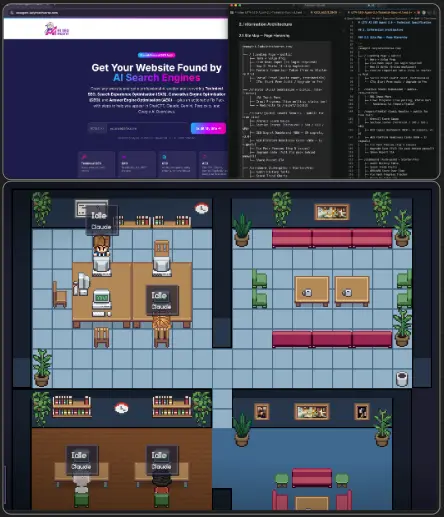
At the close of Week 1, the full product architecture is validated against the target coding language mix for the backend. The authenticated product layers that will support the 2.0 build are structured and ready.
That might sound like a lot of paperwork and not much coding. But anyone who has ever shipped a full stack production of an AI product will tell you that the architecture decisions made in Week 1 are the decisions you live with for the lifetime of the product. Getting them right is not administrative work. It is the most consequential engineering work in the entire build.
Week 2 begins with the first code commit: rewriting the GEO engine from scratch, based on the locked specification. That is where the build gets visibly messy and haywire. If you are curious about where the LITV AI SEO Agent currently stands and what a free audit feels like, you can run one at seoagent.ladyintechverse.com. The 1.0 engine is live, and it gives you a clear sense of what 2.0 is being built to surpass.
What is Coming in Week 2
The first code commit lands at the start of Week 2, and the focus is singular: the GEO engine rewrite. This is the component I consider the most strategically differentiated part of the entire 2.0 system. Most SEO tools still treat GEO as a footnote or a bolt-on checklist. The LITV AI SEO Agent is being built to treat it as a primary audit discipline, with its own specification, its own signal architecture, and its own output framework.
I will document week 2 in the coming days, and share the key decisions here in the Week 2 update. If you want to follow the build in real time, the best place to do that is here.
Building in public is not a marketing strategy for me. It is a commitment to transparency about what AI product development actually looks like when you are doing it solo, without a team, without external funding, and with uncharted terrains ahead that goes beyond the four-week sprint. Week 1 is done. Week 2 starts now. Run your free SEO audit at seoagent.ladyintechverse.com and follow the build here.
Thanks to Build Club, Annie Liao and Caroline Ciaramitaro for hosting and facilitating this 4-week immersive AI building programme.
Frequently Asked Questions (FAQ)
Internal Articles
- I Built an AI SEO Agent to Fix the Visibility Gap in AI Search
- The AI Productivity Paradox in 2025
- Agentic AI in 2025: Ripples that Signal the 2026 Workflow Tsunami
- How can CEOs use AI and Leadership to improve Crisis Communications in 2026?
- How Brands Build Human Trust in the Age of Agentic AI, Starting in 2026
- Digital Trust in 2025: Governance and Security Shaping the Next Economy
- Data Quality is the Power Move behind every winning AI Strategy in 2025
- Why more than 90% of AI Pilots Fail and How Hyper-Personalisation Wins
Visual Content Disclaimer: All media and visual assets in this post are AI-generated.
Building in Public: Week 1 of Upgrading the LITV AI SEO Agent to 2.0 (Women-in-AI | BuildClub.ai)
#WomenInAI #BuildClub #BuildingInPublic #AIProduct #AIAgent #SEOAgent #GEO #TechnicalSEO #AgenticAI #AIAccelerator #WomenWhoCode #AIMarketing #AIStrategy #LadyinTechverse #DigitalSanctuary #DigitalTransformation #MarketingTransformation #MarTech


Leave a Reply