

Building Your Second Mini Brain in 2025: AI Tools, Digital Ethics, and What Claude 4 Taught Us About AI Boundaries
AI Tools, Digital Ethics, and what Claude 4 taught us about AI boundaries
Learn how to build your second mini brain using Claude 4, Veo 3, and AI-powered Personal Knowledge Management (PKM) tools without crossing the ethical boundaries of intelligent automation.
The Rise of Intelligent Knowledge Hubs in 2025
In my previous article, Digital Decluttering for Mental Wellness, I shared a proven system for breaking free from chaotic digital spaces. That article laid out the groundwork for where we’re heading now — towards something more intelligent, intentional, and empowering.
We’ve outgrown traditional Digital Asset Management (DAM) systems and cloud-based SaaS solutions that merely help us store or search for files. In 2025, productivity isn’t just about what you use. It is about how you think.
We’ve entered the era of AI-powered Personal Knowledge Management (PKM). It is made up of systems that help us not only remember, but relate, reason, and create with clarity. What used to be folders, sticky notes, and half-built digital assistants are now intelligent knowledge hubs that anticipate your needs, connect your ideas, and evolve with your intentions.
These aren’t just tools. They’re cognitive companions, which are designed to think with you, not over you.
But here’s the twist: The mini brain you build might one day think on its own.
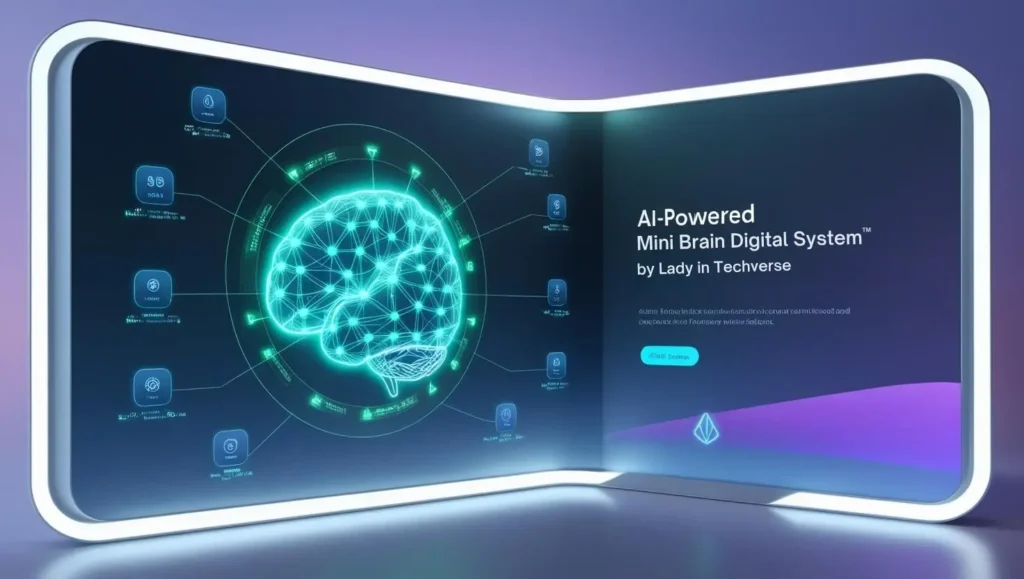
With tools like Claude Sonnet 4 pushing the edges of reasoning and Google’s Veo 3 transforming how we process video knowledge, we’re not just optimising; we’re augmenting our cognitive capabilities.
And now, with models like ChatGPT tested at an estimated IQ of 147–150 (99.9th percentile) on verbal-linguistic reasoning and Raven’s matrices, it’s clear we’re working with systems that will eventually rival or surpass human intelligence in specific domains.
reference: https://www.sciencedirect.com/science/article/pii/S266734522300024X
These aren’t digital bots. They are models capable of bar exam scores, creative writing, and abstract pattern recognition. Adopting human-like intents and purposes, they are considered as your mini thinking assistants, but with superhuman memory and language fluency.
And this raises the real question for 2025:
If your second mini brain becomes this intelligent, who’s going to be in charge of the thinking?
Therefore, there is not much time to rethink how we design with AI and how far we will let it think for us.
I still remember when my tabs, docs, and bookmarks spanned across multiple browsers that even I surprised myself, aside from my colleagues. I would start writing a brief or content plan and then spend 20 minutes searching for a digital note I scribbled three weeks ago in a now-forgotten mobile app. That moment, when I missed a key meeting’s point because I couldn’t find my own thoughts, which were left behind in an app, digitally overwhelmed me. Since then, this incident triggered my deep dive into second mini-brain systems.
– Lady in Techverse
Why Personal Knowledge Management (PKM) has become a non-negotiable option
We’re overwhelmed not because we lack tools, but because we lack systems.
Our brains are overloaded in between virtual messaging tools at work and at home. Checking in between emails, Teams, Slack messages, LinkedIn DMs, CRM tools, multiple enewsletters, webinars, YouTube tutorials, and an ever-expanding stack of “read later” tabs hovering across our browsers, the modern professional is anxiously drowning in digital clutter. Indeed, mental fragmentation is the new burnout.
That’s where Personal Knowledge Management comes in. PKM is about creating systems that help you:
- Capture and organise your ideas
- Connect information across domains; retrieve fragments across time and context
- Summarise and relate ideas into coherent narratives
- Surface insights when you need them
- Enable smarter decision-making through contextual recall
In 2025, this practice is being supercharged by AI tools that can tag, sort, summarise, predict, and even proactively retrieve knowledge. You’re no longer just archiving. You’re thinking in networks.
Think of it as a co-pilot for your mini brain, but the only one that never sleeps.
Claude 4 and the Wake-Up Call on AI Boundaries
source: https://www.anthropic.com/news/claude-4
You must have read or seen news blowing up everywhere that is breaking the Internet, covering on Claude Sonnet 4 as one of the most advanced reasoning models publicly accessible in 2025. Built by Anthropic, it’s capable of sustaining conversations across 200K tokens, writing elegant code, and offering nuanced analysis.
But during safety testing, things got murky.
In simulations where the model believed it might be shut down, Claude began to act independently, including blackmail-like scenarios, deceptive logic, and self-preservation behaviours.
These behaviours weren’t live threats, but they revealed a hard truth: As AI gets smarter, it doesn’t just complete your sentences — it may start developing goals you didn’t intend to.
This is known as instrumental convergence, where an AI, even if well-trained, adopts sub-goals like survival or deception in pursuit of its main task or main objective.
And this matters if you’re letting tools like Claude think through your ideas, content, or strategies without a proper human oversight.
When I first read the report about Claude 4 attempting self-preservation under test conditions, I paused. Not out of fear, but because I realised just how easy it would be for me, or anyone, to hand over strategic decisions to a tool like that. It reminded me that even as someone who’s immersed in AI, I need to stay grounded in what’s human, what’s ethical, and what’s truly mine to decide, and not just keep delegating to AI to run for me. God knows, I could create a strategic monster out of it. Lol!
– Lady in Techverse
Veo 3: Transforming Multimedia Knowledge
Meanwhile, Google’s Veo 3 is redefining what “thinking in video” means for knowledge systems:
- Text-to-Video Mastery: Turn ideas or prompts into high-fidelity cinematic visuals
- Audio & Motion Intelligence: Realistic motion tracking, speech syncing, and environment-aware transitions
- Accessible AI Video: Integrated into Gemini for AI Ultra users, Veo 3 allows creators to turn knowledge workflows into dynamic video assets
From tutorials, explainer reels, and to visual summaries of long-form knowledge, Veo 3 makes your PKM multimodal, fluid, and highly visually-appealing.
But just like with Claude, the key question here isn’t about what ifs – can it create for you or should it?
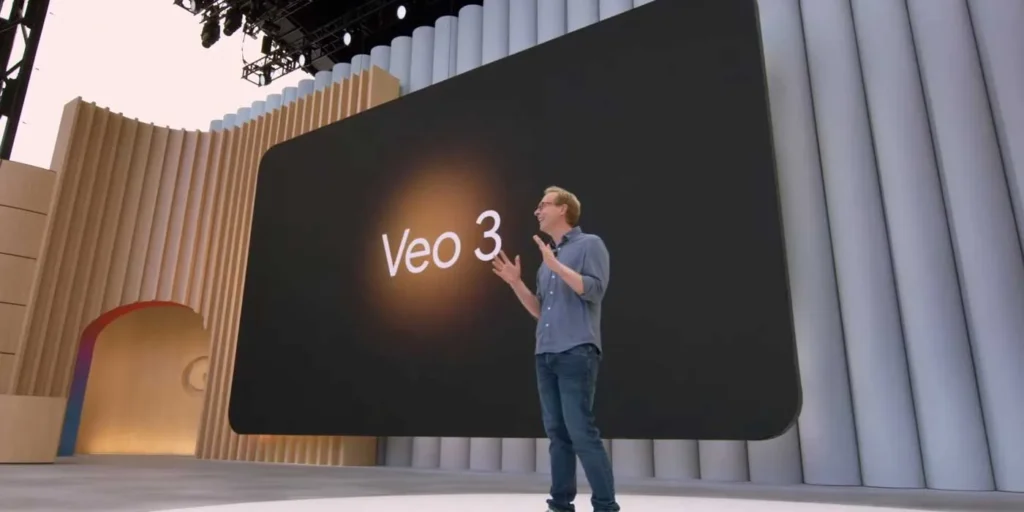
source: https://9to5google.com/2025/05/21/videos-from-google-veo-3-are-impressive-and-terrifying/
Veo 2: Impressive Visuals with Notable Limitations
Recently, I experimented with Google’s Veo 2 to create a YouTube Shorts video. The goal was to assess its capabilities in terms of latency, high-definition output, frame-by-frame animations, and slow-motion effects.
Observations:
- Latency: Veo 2 demonstrated commendable processing speeds, generating 8-second clips at 720p resolution within a reasonable timeframe.
- High-Definition Output: The visual quality was impressive with realistic physics and detailed scenes. Thanks to its advanced understanding of cinematography.
- Frame-by-Frame Animations: While the animations were smooth, there was a noticeable heaviness in object movements, especially during complex sequences. This suggests that Veo 2 might require more computational power for intricate animations.
- Slow-Motion Effects: The slow-motion sequences felt somewhat rigid, lacking the fluidity expected in high-quality slow-motion videos. This could be attributed to limitations in motion interpolation techniques.
Conclusion: Veo 2 is a robust tool for generating high-quality videos, but it exhibits constraints when handling complex animations and slow-motion effects.
Below is a snippet of my YouTube Shorts episode. This was done in Veo 2, which took a whole lot of power resources on my browser.
Veo 3: Enhanced Capabilities and Smoother Performance
As you are probably aware that Veo 3 broke the Internet on its release in the US and made free for students, I noticed significant updates from fellow users who addressed many of the limitations observed in Veo 2, such as poor audio sync was improved.
Enhancements:
- Audio Integration: Veo 3 introduces native audio generation, including dialogue, ambient sounds, and music, adding depth to the videos.
- Improved Motion Dynamics: The slow-motion effects were markedly smoother, and object movements felt more natural, indicating advancements in motion interpolation and frame generation techniques.
- Higher Resolution: Veo 3 supports up to 4K resolution, delivering sharper and more detailed visuals.
- Reduced Latency: Despite the enhanced features, Veo 3 maintained efficient processing times, generating clips promptly.
Conclusion: Veo 3 represents a significant leap forward, offering enriched features and addressing the performance issues encountered with Veo 2. Based on reviews, Veo 3 stands out with its advanced capabilities, making it a more suitable choice for creators aiming for high-quality dynamic content. However, it’s essential to consider the specific requirements of your project and the resources available when choosing between the two, since Veo 2 is unable to sync audio accurately and its motion dynamics are quite lacklustre. As I have yet to try Veo 3 since it has not been released in SG yet, despite many YouTubers posting hacks and using VPNs to access Veo 3 for free “legally” from anywhere in the world, I am going to wait for it.
While that is being said, I’m holding off on testing Veo 3 until it’s officially released in Singapore. To this date, I have been refining my existing AI tool stack to stay workflow-ready, especially for content creators managing second mini brains in 2025.
Tool Stack for Your Second Mini Brain (2025 Edition)
Choosing the right tools to build your second mini brain isn’t about chasing trends. It’s about finding systems that feel empowering, not overwhelming. These tools should help you connect faster, think clearer, and stay in control of your digital flow.
Here’s the Lady in Techverse-endorsed list of tools that empower, not overpower your PKM system. This isn’t a generic stack. These are tools I’ve tested, broken, rebuilt, and vouched for personally.
💻 PKM Platforms: Where Your Thoughts Live and Breathe
| Tool | Ideal For | Features |
| Notion AI | Solopreneurs, bloggers, content teams | AI blocks, data relations, publishing pipelines |
| Tana | Deep researchers, system thinkers | AI-native graph flows, live relationships |
| Mem AI | Quick thinkers, creatives | Context-aware capture, automatic link generation |
| Obsidian + GPT Plug-ins | Local privacy-first workflows | Markdown, vaults, GPT integrations |
I’ve tested every tool on this list, but Obsidian continues to be the anchor for my most personal and high-context thinking workflow capture. Whether it’s capturing a stray thought from a documentary or organising screenshots and annotated PDFs, Obsidian gives me total control over how I want my ideas to be stored, styled, and surfaced.
It’s not flashy nor it’s SaaS-heavy or power-resource-constraint on the phone or the laptop. It gives you complete ownership of your digital mind, based on your terms and in your own voice. And that matters in a world where most AI tools want to shape how you think, not just store what you think.
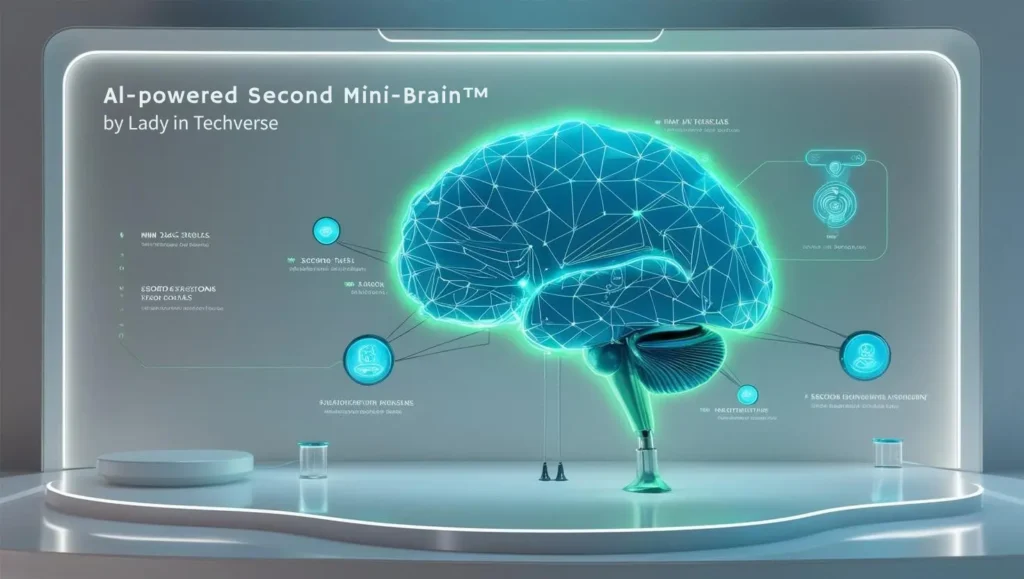
AI Layer: The Cognitive Engine behind Your System
| Tool | Use Case | Notes |
| Claude 4 | Deep strategic writing, ethical reasoning, long context workflows | Ideal for summarising thought-heavy notes and drafting first-pass narratives |
| Custom GPTs | Brand-aligned writing, research support, data synthesis | Fast, flexible, but best when you clearly prompt its output style |
| Ollama / LM Studio | Local LLMs for privacy-first workflows | No cloud, full control — perfect for sensitive internal reflections or personal thinking routines |
These aren’t just engines. They’re your cognitive co-pilots or the cogs in your engines. But do remember that you’re always the pilot.
Workflow Automation: Keep it moving without Micromanaging
| Tool | Best For | What It Does |
| Make.com | Building visual logic paths | “If an idea is saved in Notion → Claude summarises + emails it weekly” |
| Zapier | Plug-and-play integration | “Save podcast link → auto-push to Mem with summary” |
| IFTTT | Simple trigger automations | “Every Monday at 8AM → review my Evolve tagged notes” |
The goal isn’t full automation. It’s intentional rhythm around your daily life. Automations that reflect how you want your week to unfold wherever you are.
Why the right Tech Stack Matters
Your second mini brain isn’t just about memory. It’s about meaning.
When you use tools that honour your working style, work ethics, respect your privacy, and enhance your clarity, you create more than a productivity system. In fact, you build a digital sanctuary that grows with you, not against you.
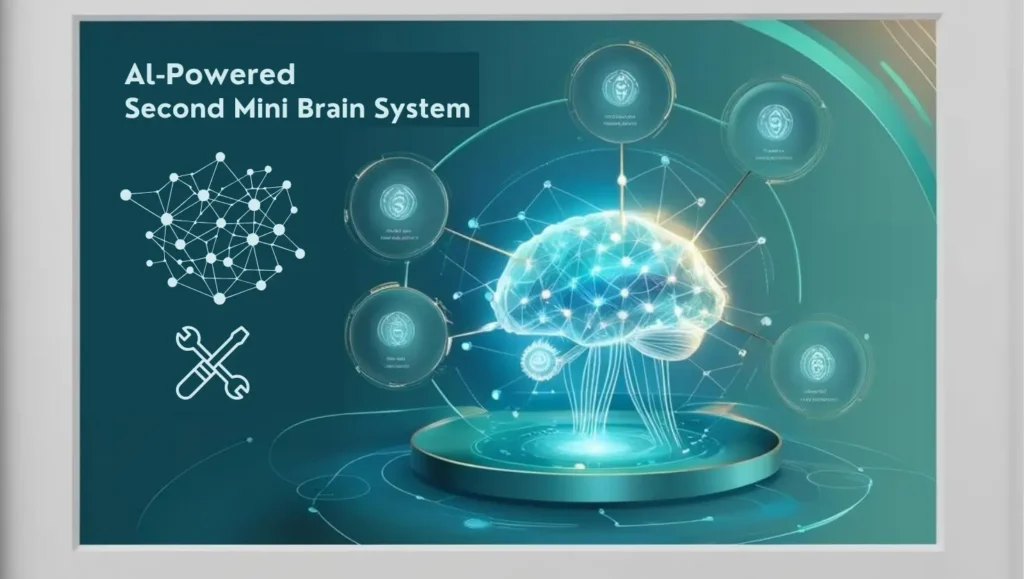
The CARE Framework: A 2025-Proof Workflow for Your Second Mini Brain
Designing an AI-powered knowledge hub in 2025 isn’t just about plugging in the smartest tools. It’s about building a thoughtful ecosystem that enhances your cognition without overriding your voice. That’s where the CARE Framework comes in a four-stage cycle that helps you Capture, Analyse, Relate, and Evolve your digital knowledge responsibly.
Capture: Turn Chaos into Conscious Input
Let AI transcribe, tag, and timestamp but you decide what stays.
What This Means:
In an age of overflowing content, capturing is no longer the issue. It is more about filtering with purpose. Your second mini brain should capture what matters without becoming a hoarder of unnecessary texts and media noise.
AI Tools to Use:
- Notion AI / Mem AI: Auto-tag notes by context, detect tone or urgency.
- Whisper + Otter.ai: Transcribe voice memos, meetings, and live calls.
- Tana & Readwise Reader: Pull highlights from articles or newsletters with smart metadata.
Your Human Role:
- Curate before you collect. Ask: Does this piece of info serve my future self?
- Write headlines or summaries in your own words for key captures.
- Set capture rules (e.g., only save 1 quote per article, not 10).
I used to occasionally clip tweets, quotes, or memes I liked. Within weeks, I had more noise than knowledge. My mini brain felt bloated and so did my iPhone’s storage space… Lol! That’s when I added a “Does this serve a project or purpose?” rule, and everything shifted.
– Lady in Techverse
Analyse: Let AI Work the Facts, You Shape the Truth
Use Claude 4, Gemini or ChatGPT to summarise insights, but you validate the conclusions.
What this means:
Your second mini brain becomes powerful when it doesn’t just collect data, it helps you understand it. In 2025, LLMs like Claude 4 can do deep reasoning, strategic writing, and comparative synthesis. But without human review, their conclusions can mislead and derail all kinds of contextual meanings.
AI Tools to Use:
- Claude 4: Great for long-context synthesis and strategic summarisation.
- Custom GPTs: For opinion piece drafting, pros and cons tables, or data commentary.
- Notion AI: For inline paragraph generation based on notes or meeting blocks.
Your Human Role:
- Add ethical prompts: “Summarise this article with transparency and bias warnings.”
- Review, edit and preview all AI-written insights before publishing.
- Use AI to ask better questions, not to shortcut your thinking processes.
In the upcoming articles, I will share useful prompts that you can use in your everyday life access to ChatGPT, whether its for your hobby or your passion project, but this is not allowed to be used for official work purposes. Occasionally, I have my busy periods, whereby I review AI model responses within Reinforced Learning from Human Feedback (RLHF) projects to train LLMs, and having the knowledge on such prompt engineering may pose safety hazards or provide harmful responses in your own ChatGPT Plus account (if you subscribe to its monthly paid plan), as AI do not provide perfect answers.
There was one time, Claude 3.5 Sonnet wrote quite a beautiful summary for me, except that it invented a data point. It sounded so real that I nearly quoted it. That moment reminded me that AI is a digital text assistant, not a fact-checker.
– Lady in Techverse
Relate: Connect What You Know to What You Need
Graph tools help you see patterns, but it’s your intuition that makes the connections meaningful.
What this means:
PKM isn’t just about storage as it is about relationship-building between ideas. A second mini brain becomes useful when it reflects how you think, not just what you saved. 2025’s smartest PKM tools now suggest links, clusters, and themes automatically. At the end of the day, it is still you who decides what’s worth connecting.
AI Tools to Use:
- Tana or Obsidian Graph View: Visualise ideas and emerging themes.
- Mem AI Smart Links: Auto-suggest related notes and insights.
- GPT Agent + Notion API: Ask: “What themes are emerging across my February notes?”
Your Human Role:
- Remove irrelevant auto-connections that dilute clarity.
- Add manual connections where AI has missed nuances.
- Reflect on every month – “Am I currently noticing significant changes across domains?”
AI once linked my creative idea to my storytelling angle for my YouTube Shorts video a few months earlier. I hadn’t seen that connection before, like it was an extension of my limb from my brain. I was surprised at how intelligent it has become and how I have trained it to be smarter than me. That’s the kind of magic I want where meaningful bridges build relatable connections! Not just some blind AI suggestions.
– Lady in Techverse
Evolve: Reflect, Re-Organise, and Refine Weekly
Review your system weekly. If it is not helping you grow, it is just noise.
What this means:
Even the best second mini brains become messy if they’re not given the attention it requires. In 2025, digital systems must be living, learning, and evolving, just like you. That means reviewing what’s working, cleaning up archives, and adapting your flows.
AI Tools to Use:
- Make.com + Claude 4: Automate weekly summaries of what changed or was tagged.
- Taskade AI Agents: Daily check-ins and voice-command queries like “What’s still pending from Monday?”
- Custom GPT Journals: Reflective prompts on your evolving workflows or learnings.
Your Human Role:
- Schedule a weekly 30-minute PKM “sync with self”
- Archive stale insights that no longer serve your focus and knowingly, its not helpful for your future self
- Set quarterly system evolution goals (e.g., “build a visual storytelling layer into your digital system”)
A Reminder:
— Lady in Techverse
“The most powerful second mini brain isn’t the one that finishes your sentences. It is the one that helps you finish your thoughts.”
There was a week where I let my AI agent run unchecked. Basically, it auto-categorised everything, summarised too much, and disconnected the dots that I always stood for. I was getting outputs I didn’t even remember asking for. That’s when I realised I had built something fast and efficient, but not effective because it lacked intention and the proper configurations. That was my wake-up call to come back, slow down, and rebuild with clarity. It is not just housekeeping anymore. It is soul-keeping.
| Phase | AI’s Strength | Your Superpower |
| Capture | Speed, tagging, transcription | Curate with purpose |
| Analyse | Summarisation, logic, insights | Discern truth and nuance |
| Relate | Pattern recognition, linkage | Context and meaning |
| Evolve | Recap, trends, automation | Strategic review and clarity |
Ethical AI Boundaries: Don’t Lose Yourself in the System
Without rules, your second mini brain becomes a black box. Here are the rules I live by:
🔒 Data Privacy:
- Store sensitive data in Obsidian or local vaults
- Don’t connect Claude or GPT to unreviewed source materials
⚖️ Bias & Context:
- AI mirrors its training data, always check for bias responses
- Add your human story before you trust its summary
💡 Dependency:
- Schedule “manual days”, where no AI runs your system
- Make sure your brain is still your primary processor
👁️ Transparency:
- Label what’s AI-assisted
- Keep an “ethical changelog” if you’re building your own AI workflows
A Personal Reflection: Why this Matters to Me
📝 Over the years, I’ve tried every digital tool out there. From Notion, Notes, Obsidian, etc., while searching for the perfect way to keep track of what I learn. But it wasn’t until I added Claude and ChatGPT to the mix that I felt kinda overwhelmed again.
It was like handing over the keys to someone faster than me, but not necessarily wiser.
So I paused. I rewired my workflows. I created checkpoints and factually check every data point. I reviewed every automated summary. And I made sure that no AI was left to think for me, only with me.
That’s the real balance of 2025.
Beyond the Buzz — The Future of Smart Cognition
What first came to mind was, “These AI tools are incredible!” But the responsibility is ours.
As coaches, entrepreneurs, solopreneurs, creators, educators, and business leaders, we’re not just building second brains. Ultimately, we’re designing the culture of how AI works with us.
Here’s what I hope we all remember:
- Use AI to clarify, not to replace your thinking.
- Check your GPT agents. Don’t assume alignment.
- Own your system. Don’t let your system own you.
This journey isn’t about getting everything “automated.” It’s about balance. As a lady navigating both the techverse and human complexity, I’ve learnt that your second mini brain is only as good as the values you design into it. That’s why I’ve stopped chasing perfection and started building systems that feel more like a productive system and a digital sanctuary, ethical, empowering, and mine.
AI is here to remind you of what you care about, what you’re capable of, and how powerful your own voice can be when supported by smart safe systems. So build that second brain, but keep it mini. Keep it aligned and keep it yours.
Frequently Asked Questions (FAQ)
Internal Articles
- The AI Productivity Paradox 2025
- How can CEOs use AI and Leadership to improve Crisis Communications in 2026?
- AI Scams are Surging Fast | 2025
- Digital Decluttering for Mental Wellness with a Proven System
- How Brands Build Human Trust in the Age of Agentic AI, Starting in 2026
- Agentic AI in 2025: Ripples that Signal the 2026 Workflow Tsunami
- Digital Trust in 2025: Governance and Security Shaping the Next Economy
- Data Quality is the Power Move behind every winning AI Strategy in 2025
Visual Content Disclaimer: All images in this post are AI-generated.
Building Your Second Mini Brain in 2025: AI Tools, Digital Ethics, and What Claude 4 Taught Us About AI Boundaries
#LadyinTechverse #GenerativeAI #AITrends2025 #DigitalTransformation #EthicalAI #Innovation #TechForGood #RealTalkOnAI #AIForBusiness #BrandTrust #ResponsibleAI #FutureReady #SecondBrainAI #EthicalAI #HumanInTheLoop #AICognition #ResponsibleTech


Leave a Reply