

Marketing AI Readiness: How to Prepare Your B2B Team for Agentic AI
Most B2B marketing teams are building agentic AI systems on top of a readiness gap they have probably never diagnosed.
A marketing AI readiness assessment evaluates whether a B2B marketing team’s data quality, process documentation, team capability, and governance structures can support autonomous AI workflows. Completing it before deployment reduces failure risk and ensures AI agents operate on inputs that are accurate and structured enough to produce reliable output.

Why Agentic AI Deployment Fails Before It Begins
When B2B marketing leaders are approaching agentic AI, they begin with tool selection: which platform, which vendor, which AI model handles content at scale. The structural question, whether the function that will operate these tools is prepared to do so, arrives later, often after the contract is signed.
McKinsey’s State of AI 2024 (McKinsey Global Institute, May 2024) documented this gap at scale. Across organisations that had reached near-majority AI adoption, teams consistently reported difficulty linking AI activity to measurable business outcomes. That failure does not typically originate in the technology. It originates in the absence of structural conditions that allow AI to function reliably: clean data, documented processes, trained teams, and governance frameworks that catch errors before they compound.
Specifically for B2B marketing, deploying agentic systems into an unprepared function produces predictable failures. AI agents operating on unstructured or inconsistent CRM data will generate briefs for the wrong audience segments. Autonomous publishing workflows applied to processes that have not been defined in rules will produce off-brand output. Teams that have not been trained to review and override AI decisions will over-trust the system at exactly the moments when scrutiny matters most. None of these failures is the tool’s fault. All of them are foreseeable from a readiness assessment conducted before deployment begins.
The case for a pre-deployment readiness assessment is commercial, not procedural. An agentic system that fails in production costs significantly more to diagnose and remediate than one delayed by three weeks while foundational conditions are established. This is the operational logic that many marketing leaders learn after the fact.

The Four-Dimension AI Readiness Framework
The framework below assesses marketing AI readiness across four dimensions: data quality, process definition, team capability, and governance structure. Each dimension operates as a gate rather than a score. A critical gap in any one dimension creates systemic risk across the entire agentic workflow, regardless of how well the remaining three dimensions are positioned.
This is the distinction that matters for marketing leaders. A readiness assessment is not a checklist to complete once and file. It is a diagnostic that identifies which dimension is the binding constraint on deployment, and therefore where to focus remediation effort first.
Dimension One: Data Quality
Agentic AI systems are data-dependent in a way that rule-based automation is not. Traditional automation handles incomplete inputs with conditional logic. An AI agent trained to act on your marketing data will amplify the quality of that data at scale, producing outputs that are as reliable, or as unreliable as the data it acts on.
The data quality assessment for a marketing function covers three areas. The first is CRM data integrity: whether contact records are complete, deduplicated, and tagged consistently enough for an AI agent to make reliable audience segmentation decisions. The second is content performance data: whether analytics are tracked at a sufficient granular level via UTMs, engagement events, and conversion paths just to give an AI agent meaningful inputs for content optimisation decisions. The third is historical process data: whether previous campaign data is structured in a way that allows pattern recognition rather than requiring manual interpretation at each step.
A practical marker for this dimension: if your team regularly debates which CRM data field is the source of truth for a given attribute, your data quality is not yet sufficient to support agentic automation of workflows that depend on that attribute. Resolve that debate before configuring the agent.
Dimension Two: Process Definition
AI agents execute rules. If the process you want to automate has not been documented in explicit, rule-executable steps, the agent cannot be configured to execute it reliably. This is one of the most consistently underestimated readiness gaps in agentic AI deployment.
Process definition readiness asks two questions. First: which marketing processes does your team run that are repeatable, have clear inputs and outputs, and are not dependent on contextual human judgement at every step? These are the processes that can be modelled for agentic automation. Second: have those processes been documented in enough detail that a new team member could follow them without asking for clarification? If the answer to the second question is no, the process is not ready for agent execution. The agent will ask no questions and will fill ambiguity with inference.
Common processes that clear this bar for most B2B marketing functions include keyword research briefing, social caption production from approved blog posts, SEO audit scheduling, and performance report generation from defined data sources. Less commonly ready at this dimension are campaign planning, account-based marketing sequences, and any content process that requires brand voice judgement without a documented codex.
Dimension Three: Team Capability
Agentic AI does not remove the need for human judgement in marketing. It concentrates that judgement at higher-value decision gates: prompt design, output review, error escalation, and strategic direction. A team that has not been prepared for this shift will either over-delegate to the AI, failing to catch errors that compound across a workflow, or underuse it, hence defaulting to manual processes that defeat the productivity case entirely.
Team capability assessment covers four areas. AI literacy is the first: whether the team understands at a functional level – what an agentic system is doing and what its failure modes look like. Prompt design is the second: whether team members can write clear, constrained prompts that produce reliable outputs. Output review is the third: whether team members have the critical reading skills to identify AI-generated content that passes casual inspection but fails on accuracy, brand voice, or audience fit. Escalation judgement is the fourth: whether team members know which situations require human override rather than AI continuation.
The minimum viable team capability for a B2B marketing function deploying agentic AI is not technical. It is a clear mental model of what the system can and cannot do, combined with the confidence to intervene when outputs do not meet the standards the function is accountable for.
Dimension Four: Governance Structure
Governance is the dimension most frequently deferred until after deployment. This is the wrong sequence. A governance structure for agentic AI in marketing defines three things before the first workflow goes live: who has approval authority at each decision gate, what the audit trail for AI-generated decisions looks like, and what the escalation path is when an AI-generated output is flagged as inaccurate, off-brand, or non-compliant.
For B2B marketing leaders in Singapore, Singapore’s AI Verify Testing Framework and IMDA’s 2024 Model AI Governance Framework for Generative AI provide credible reference points for structuring AI governance before deploying AI into marketing workflows. AI Verify includes transparency, explainability, data governance, accountability, and human agency and oversight among its recognised governance principles. When applied to marketing, this means every AI-generated content workflow should have a documented prompt, identifiable data input, named human approver, audit trail, escalation path, and correction or rollback mechanism before it goes live. The workflow should also allow controlled edits and continuous improvement because AI use cases, data sources, integrations, and risk controls will evolve as the technology matures.
A governance structure that is not in place before deployment is significantly harder to retrofit once agentic workflows are running at volume. The volume of output that makes agentic AI valuable is the same volume that makes retrofitting governance after the fact, a far more costly and complicated exercise.

How to Run Your AI Readiness Assessment
The assessment itself does not require a specialist engagement. It requires honest answers to structured questions across each of the four dimensions, reviewed collectively by the marketing leader and the team members who will operate the agentic system day to day.
The practical process runs in four steps. First, map the specific workflow you intend to automate. Write it out as a sequence of steps with defined inputs, outputs, and decision points. Any step that cannot be described without a contextual qualifier, such as “it depends” or “based on the situation,” is a process definition gap that must be resolved before agent configuration begins.
Second, audit your data quality against the inputs that workflow requires. Pull a representative sample of the data the agent will act on and evaluate it against consistency, completeness, and accuracy. If your data requires manual cleaning before the sample can be meaningfully reviewed, document that as a pre-deployment data infrastructure requirement.
Third, run a team readiness conversation. Ask the team members who will manage the agentic system to walk you through what they understand the system will do, what they believe the failure modes look like, and how they would identify an output that should be escalated rather than approved. The gaps in that conversation are your training requirements.
Fourth, document your governance model before configuration begins. Name the approval owner for each decision gate, define the audit trail format, and establish the escalation path. Communicate this model to all stakeholders before the first workflow goes live.
This process takes between one and three weeks for a B2B marketing function of standard size. Any agentic deployment that cannot be delayed by this margin for a structured readiness assessment carries a failure risk that is almost certainly higher than the commercial return from an earlier launch date. This is not conservative thinking. It is the operational logic that separates deployments that compound in value over time from those that require costly remediation after launch.
Download Marketing AI Readiness Checklist 2026 by LadyinTechverse (.XSLX)
Here’s a not-so-simple checklist to help you identify if the marketing team is ready for Agentic AI implementation 😅

file size: 84kb from a shared Onedrive folder

The Singapore Context: IMDA AI Verify and What It Means for Marketing Leaders
Singapore’s AI governance environment is more structured than most APAC markets, and this is commercially relevant for B2B marketing leaders operating in or selling into the region. IMDA’s AI Verify Framework (IMDA, 2024) establishes a governance testing structure for AI systems that includes principles directly applicable to marketing function deployment: accountability, data governance, robustness, and human-in-the-loop design.
For marketing leaders in Singapore, AI Verify is not a regulatory obligation for most marketing AI deployments. It provides a credible reference framework for structuring internal governance that satisfies board-level scrutiny and client-facing due diligence. Enterprise Singapore’s guidance on AI adoption for SMEs reinforces the same principle: structured governance before deployment, not as an afterthought.
The practical implication is that conducting and documenting a pre-deployment readiness assessment positions AI adoption as a governed business function rather than an experimental one. This distinction matters at board level, and it matters in client relationships where your organisation’s AI governance posture is becoming part of the trust evaluation. Governance implemented before the first deployment is not overhead. It is a competitive differentiator in a market where most teams are still treating agentic AI as a trial.
For context on how agentic AI trust operates across the broader buyer relationship, see How Brands Build Human Trust in the Age of Agentic AI. For the governance risk landscape that makes this readiness gap commercially significant, see AI Intensifies Work and Multiplies Risk According to HBR’s 2026 Governance Research.
My Personal Anecdote
As per my previous post, where I’d mentioned that I am currently building and growing a group of agents that are powering LadyinTechverse platform.
What I started from has grown to be an Agentic OS by itself. It was one of those days that a streamlined workflow broke because one of the agents couldn’t read the data provided by the other agent, and then one of the agents decided to update me via my Telegram (Claude tends to override certain constraints when it thinks it is doing the right thing), and signed off as LITV Agentic OS, when I didn’t even give it a name. I think if I run a journal on this, it would take me hours or even days. Hmm…I will find one day to present it here on how I built them, organised their structures, roles, and workflow processes in a gist. I do believe in use cases that can benefit lean in-house teams or even solo operators.
After all, modern AI assistants were popularised through a one-to-one chat interface. ChatGPT, Claude, Gemini, Bing Copilot and DeepSeek often feel like a private conversation between one person and one model. But that interface can be misleading in a business setting. The underlying systems are no longer just chat companions. They are general-purpose language and reasoning engines that can be connected to workflows, data sources, APIs, agents, and enterprise processes. That is why marketing leaders cannot govern them as casual productivity tools. They need operating rules, review gates, audit trails, and clear human accountability before agentic AI is allowed to act inside the function.
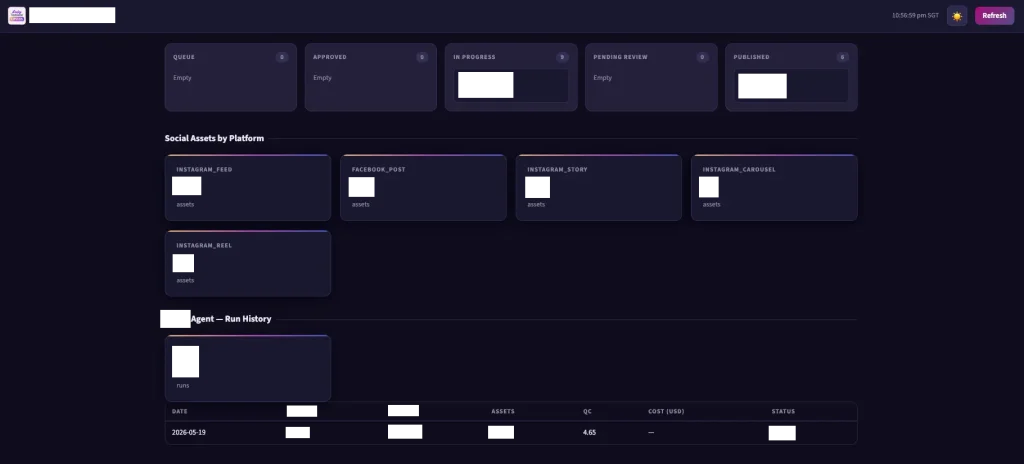
Below is a glimpse of my own LITV OS internal dashboard, showing public platform pipeline updates and scheduled runs managed by my local agents. My second mini OS brain is not shown here.
I started building this a few months ago, beginning with one local AI agent designed to work alongside Make.com. That became two agents, and the system has now grown into five local AI agents so far. For this current pipeline, Make.com is no longer in use.
Streamlining the process and cementing the operating foundation has not been easy. I have decided to keep the current setup at five agents for now, although the full lifecycle I am designing would likely need at least eight specialised agents to run end to end.
The workflow is almost there, but it still breaks occasionally. One common issue is that an agent may miss a read from a shared file used by the other agents. Occasional timeout runs are also expected in multi-agent workflows, especially when long context, large file reads, model latency, API limits, and token usage are involved.
I will share the Make.com scenario that I built from scratch previously when the time is right.
Speaking of which, Claude Design System is not brilliant yet. But it’s learning its way and definitely heading the right direction. We shall see while I test it out rigorously.
Final Thoughts: The Bottom Line
Agentic AI in B2B marketing functions is not a question of whether to adopt. For organisations committed to scaling content output, improving SEO performance, and operating marketing workflows with greater consistency and speed, the capability is demonstrably valuable. The question is whether the conditions for adoption are in place before deployment begins.
The four-dimension readiness assessment described in this post, covering data quality, process definition, team capability, and governance structure is a practical diagnostic that takes between one and three weeks to complete. It costs nothing beyond the time of the people involved, and it measurably reduces the probability of the failure modes McKinsey identified as endemic to agentic AI adoption: technology deployed onto unprepared organisational foundations with no clear mechanism for linking AI activity to business outcomes.
The marketing functions that build sustainable competitive advantage from agentic AI are not the first to deploy. They are the ones that deploy with the readiness conditions in place, measure the outcomes from the first workflow, and compound that capability deliberately over time. The difference between these two groups is not budget or technical sophistication. It is the discipline to ask the readiness question before the vendor contract is signed.
If you are a B2B marketing leader in Singapore or APAC preparing to deploy agentic workflows, the LITV AI SEO Agent offers a practitioner-tested starting point for diagnosing whether your digital presence is ready for AI-era discovery. Its four-framework audit model covers Technical SEO, SXO, GEO, and AEO, translating visibility risks into prioritised actions your team can review, approve, and remediate before scaling AI-assisted marketing workflows. When used alongside your internal governance process, it provides marketing leaders a clearer evidence trail for what needs to be fixed, why it matters, and what should be reviewed before deployment. Try it at seoagent.ladyintechverse.com.
For context on how AI search visibility compounds alongside agentic content workflows, see Generative Engine Optimisation: How to Get Cited by AI in 2026.
A marketing team is not exactly AI-ready because it owns the right tool stack. It is AI-ready when the data, process, people, and governance conditions are strong enough for the tool to operate without creating avoidable risk.
– fahiza s.
Frequently Asked Questions (FAQ)
Internal Articles
- Generative Engine Optimisation: How to Get Cited by AI in 2026
- Personal Brand Authority in 2026: The One Asset AI Cannot Copy
- Agentic AI in 2025: Ripples that Signal the 2026 Workflow Tsunami
- Synthetic Content, AI Influencers and the Fight for Authenticity in Marketing
- From Server to Sanctuary: Building for Agents, Living for Real?
- How can CEOs use AI and Leadership to improve Crisis Communications in 2026?
- Answer Engine Optimisation: How B2B Brands in Singapore Get Cited in AI Search in 2026
- I Built an AI SEO Agent to Fix the Visibility Gap in AI Search
- The AI Productivity Paradox in 2025
- How can CEOs use AI and Leadership to improve Crisis Communications in 2026?
- How Brands Build Human Trust in the Age of Agentic AI, Starting in 2026
- Digital Trust in 2025: Governance and Security Shaping the Next Economy
- Data Quality is the Power Move behind every winning AI Strategy in 2025
Sources Referenced
- McKinsey and Company — The State of AI in 2024: GenAI Adoption Spikes and Starts to Generate Value
- IMDA — AI Verify Framework and Toolkit
- Google Search Central — Creating Helpful, Reliable, People-First Content
- Enterprise Singapore — AI Adoption for SMEs
Visual Content Disclaimer: All images in this post are AI-generated.
Marketing AI Readiness: How to Prepare Your B2B Team for Agentic AI
#LadyinTechverse #DigitalSanctuary #DigitalTransformation #MarketingTransformation #MarTech #AIReadinessAssessment #AgenticAI #B2BMarketingAI #MarketingAutomationStrategy #AIForMarketers #AIImplementationStrategy #AIDeployment #AgenticWorkflows #AIMaturityModel #MarketingAI #AIStrategy #B2BMarketing #MarketingOperations #AIAdoption


Leave a Reply