

I Built an AI SEO Agent to Fix the Visibility Gap in AI Search
Your website might rank on the first page of Google and still be completely invisible to the AI systems your audience is actually using right now. That is not a warning about the future. It is a description of what is already happening, and the gap between where your rankings sit and where your visibility actually lives is wider than most marketers and founders have yet to reckon with.
This is why I built the LITV AI SEO Agent, and why it took longer than it probably should have. Let me tell you the honest version.
The Visibility Gap Nobody Is Talking About Honestly Enough
Previously, almost every week I speak with marketers, business owners and founders who describe the same experience. Traffic is dropping and so is their sales. Enquiries have slowed down. Rankings on Google look fine, or close enough to fine, but something has clearly shifted in how their audiences are finding them. Most attribute it to algorithm changes, seasonality or budget constraints. Very few could name the actual cause.
The cause is that the evolving search and discovery landscape has fractured multiple surfaces, and most brands are only optimised for one of them. AI Overviews are actively reducing click-through rates on Google itself. ChatGPT Search, Perplexity, Claude, Google Gemini and voice assistants are now answering questions that previously sent users to your website. If your content is not structured in a way those systems can crawl to parse, cite and trust, you simply do not exist in those results, regardless of how well you rank in a traditional search engine results page.
This is the visibility gap. And it is not a problem you can solve by adding more keywords or publishing more weekly content. It requires a different kind of audit entirely.
What the Four Audit Frameworks Mean
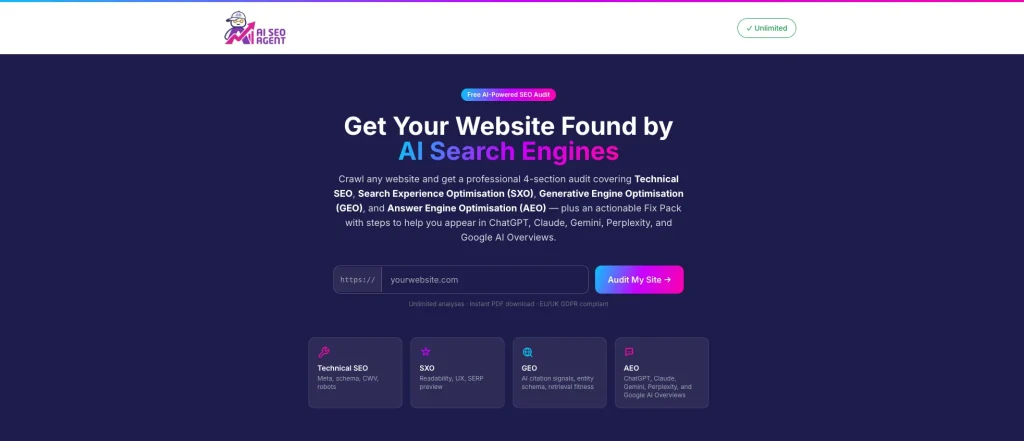
The LITV AI SEO Agent audits any public website URL across four frameworks simultaneously. It does not mean four frameworks sound impressive, but because each one measures a genuinely different dimension of visibility and signals that the others cannot capture on their own.
“I developed the AI SEO Agent with research-backed papers that have evidently been brought up to highlight and discuss among AI researchers, engineers and industry peers in this AI Marketing era.”
– LadyiNTECHVERSE
Technical SEO — The Foundation AI Crawlers Depend On
Technical SEO is the structural backbone of your website. It covers how your pages are indexed, how your schema markup is implemented, whether your crawl paths are clean and whether your site architecture gives both search engines and AI systems the signals they need to understand what your content is about and why it should be trusted. Without a solid technical foundation, everything else built on top of it is ultimately fragile. As I covered in the context of the MarTech wake-up call that defined 2026 strategy, the brands that will hold their ground are those who invested in the infrastructure beneath their content, not just the content itself.
SXO — Search Experience Optimisation
SXO sits at the intersection of SEO and user experience. It measures how well your content actually serves the reader, not just the algorithm. Page clarity, content hierarchy, readability, mobile experience, and how quickly a visitor can find the answer they came for all contribute to SXO signals. AI systems increasingly evaluate content through a lens that resembles how a human reader would experience it, which means thin, jargon-heavy or poorly structured pages take a compounding visibility penalty across both traditional and AI search surfaces.
GEO — Generative Engine Optimisation
GEO is the practice of structuring your content so that AI-powered search engines, specifically those using large language models to generate conversational answers, can cite you accurately. Perplexity, ChatGPT Search, Gemini, Claude and Google AI Overviews all draw from indexed web content, but they prioritise sources that are factual, clearly structured, authoritative and up to date. GEO asks whether your content is built to be cited, and not just read. This is one of the most underinvested dimensions of search strategy in 2026, and one of the highest-leverage areas for brands willing to do the deep end work of monitoring and researching into the key prompts. These impactful key prompts that trigger the customer’s awareness, decision-making and buying journeys are then identified to track. And the cycle repeats itself after days or even a week.
AEO — Answer Engine Optimisation
AEO is specifically about whether your content is structured to deliver direct, extractable answers to the questions your audience is asking. FAQ schema, question-based headings, concise 40 to 60 word answers, and structured data all contribute to AEO performance. The goal is to appear not just in ranked results but in AI Overviews, voice responses and featured snippet positions that are increasingly the first and sometimes only thing a user sees. Given that agentic AI is reshaping how discoverability works in 2026, AEO is no longer optional for brands that rely on organic traffic.
The Builder Story — Raw, Honest and Human
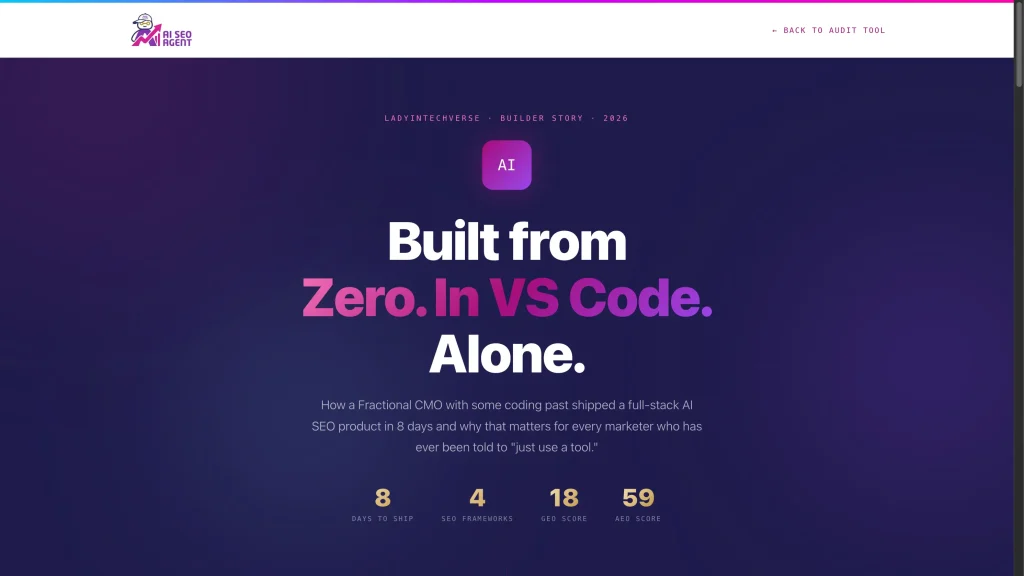
Here is the version I did not put in the press release. The idea for this tool had been sitting in a folder for months before it became a product. The concept was clear. The need was obvious. What was less clear was whether I had the time, the technical depth and the willingness to push through the parts where the build stalled, the LITV infrastructure needed revisiting, and the product felt further away than when I had started.
What changed was a combination of conviction and tooling finally meeting in the same moment. Once the technical foundation clicked into place, v1.0 came together across an intense stretch of focused building that reminded me why I find this work meaningful in the first place. Practitioners build because they have lived the problem. I have sat across from such marketing meetings, business, product, marketing and tech professionals staring at website traffic reports to know that the diagnostic gap was real, costing people money and credibility, and was not being filled by any tool already on the market in the way I needed it to be. This is different as the focus isn’t entirely on GEO, which has been the buzzword since last year after the release of some research papers and industry insights packaged with evidence of search results across ChatGPT and Perplexity.
The builder story is detailed in full at the LITV AI SEO Agent builder story page if you want the longer version. What matters here is that the tool was built from a practitioner’s frustration, not from a product roadmap drawn up in a digital canvas.
Why Technical SEO is the Foundation AI-driven Search Engines Depend On
There is a misconception worth addressing directly. Some marketers treat Technical SEO as a one-time setup task, something you sort during a website launch and revisit once every 3 to 6 months, or a year. In the context of AI search, this is a critical error. AI systems that generate search responses do not just read your content. They evaluate the structure around your content: the schema, the crawl directives, the entity signals, the internal link architecture and the signals that tell a language model whether your site is a trustworthy source worth citing.
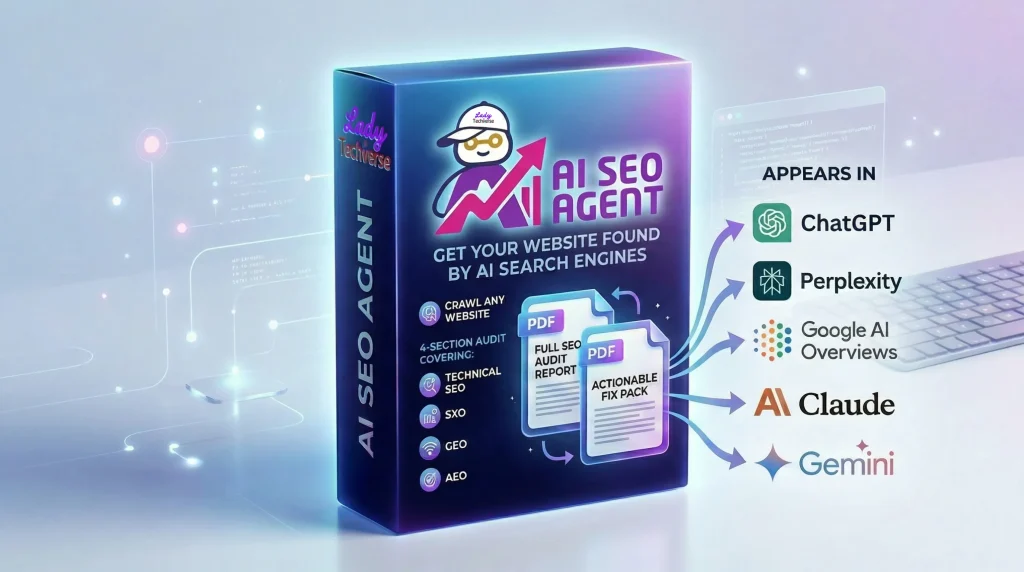
A website with strong content but weak technical foundations will consistently lose citation opportunities to a competitor with average content and excellent technical architecture. That is the current reality of AI search, and it is the reason the LITV AI SEO Agent treats Technical SEO as the first and most foundational layer of the audit rather than an afterthought appended to the end of a content review.
The Fix Pack — Prioritisations are not Checklists
Every audit the tool generates closes with a Fix Pack. This is deliberately not a full checklist of every issue found across all 4 frameworks. Handing someone a list of 40 issues with no clear indication of which ones matter most is not a diagnostic; it is an anxiety spike in a document form.
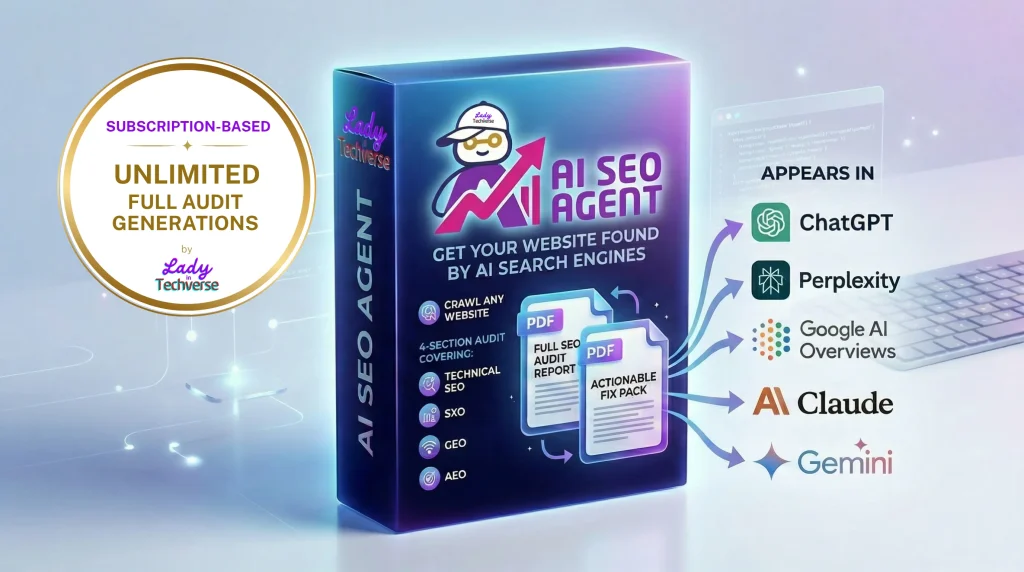
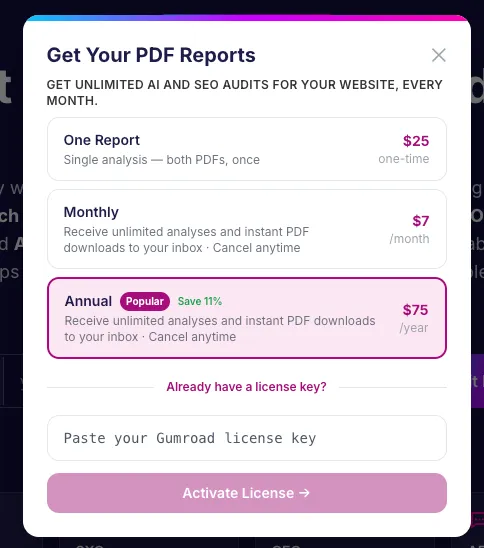
You can choose either monthly or yearly subscription option from the dropdown menu on Gumroad.
The Fix Pack prioritises remediation into what to address immediately, what to schedule for the next cycle and what represents longer-term structural work. The goal is to give you a clear starting point, not an overwhelming inventory of everything that could theoretically be improved. Clarity beats comprehensiveness (let’s say average coherence). That philosophy is built into the product at every level.
Pricing and Accessibility
The LITV AI SEO Agent is live now at seoagent.ladyintechverse.com. The free tier gives you one full audit per day. For unlimited audits and PDF report downloads, paid plans start at USD $7 per month, or an annual subscription at USD $75 and a one-time purchase option at USD $25, all available via ladyintechverse.gumroad.com. The AI SEO Agent was built in mind with EU / UK GDPR and PDPA compliance. No personal data is stored and no login is required to run your first audit.
A Free Tool Accessible for Anyone Who Finds Prompt Writing Confusing
One thing I hear consistently from people who have only recently started using Generative AI is that they do not know how to write a prompt that produces something useful. They open Gemini or ChatGPT, stare at the blank input field, type something vague, get a generic response, and conclude that AI is not as impressive as advertised. That conclusion is always a prompt quality problem, not a model quality problem or vice versa.
The tool is built for exactly this type of person. Whether you are a marketer trying to draft social media content, a founder preparing for a pitch reel, or someone using AI for personal or professional purposes (for the first time), it generates structured, ready-to-use prompts that you copy and paste directly into your preferred AI-assisted platforms. It removes the blank page problem entirely. No prompt engineering expertise required. It works pretty well with Gemini and ChatGPT.
It was built because the biggest barrier to AI adoption I consistently observe is not scepticism about the technology. It is that people simply do not know how to ask the right questions. That is not a complex problem, and this prompt tool, in any way, can help them to solve it.
Frequently Asked Questions (FAQ)
Internal Articles
- Vibe Coding is Rewriting Digital Services
- Digital Trust in 2025: Governance and Security Shaping the Next Economy
- Data Quality is the Power Move behind every winning AI Strategy in 2025
- How Brands Build Human Trust in the Age of Agentic AI, Starting in 2026
- The AI Productivity Paradox in 2025
- Agentic AI in 2025: Ripples that Signal the 2026 Workflow Tsunami
- Why more than 90% of AI Pilots Fail and How Hyper-Personalisation Wins
Sources Referenced
- GEO: Generative Engine Optimization
- The Impact of AI-Powered Search on SEO: The Emergence of Answer Engine Optimization
Visual Content Disclaimer: All images in this post are AI-generated.
I Built an AI SEO Agent to Fix the Visibility Gap in AI Search
#AISearch #SEOStrategy #LadyinTechverse #DigitalSanctuary #DigitalTransformation #GEO #AEO #TechnicalSEO #SXO #AITools #DigitalTransformation #SearchVisibility #CMO #AIMarketing #SEOAudit #GenerativeEngineOptimisation #AnswerEngineOptimisation #MarTech


Leave a Reply