
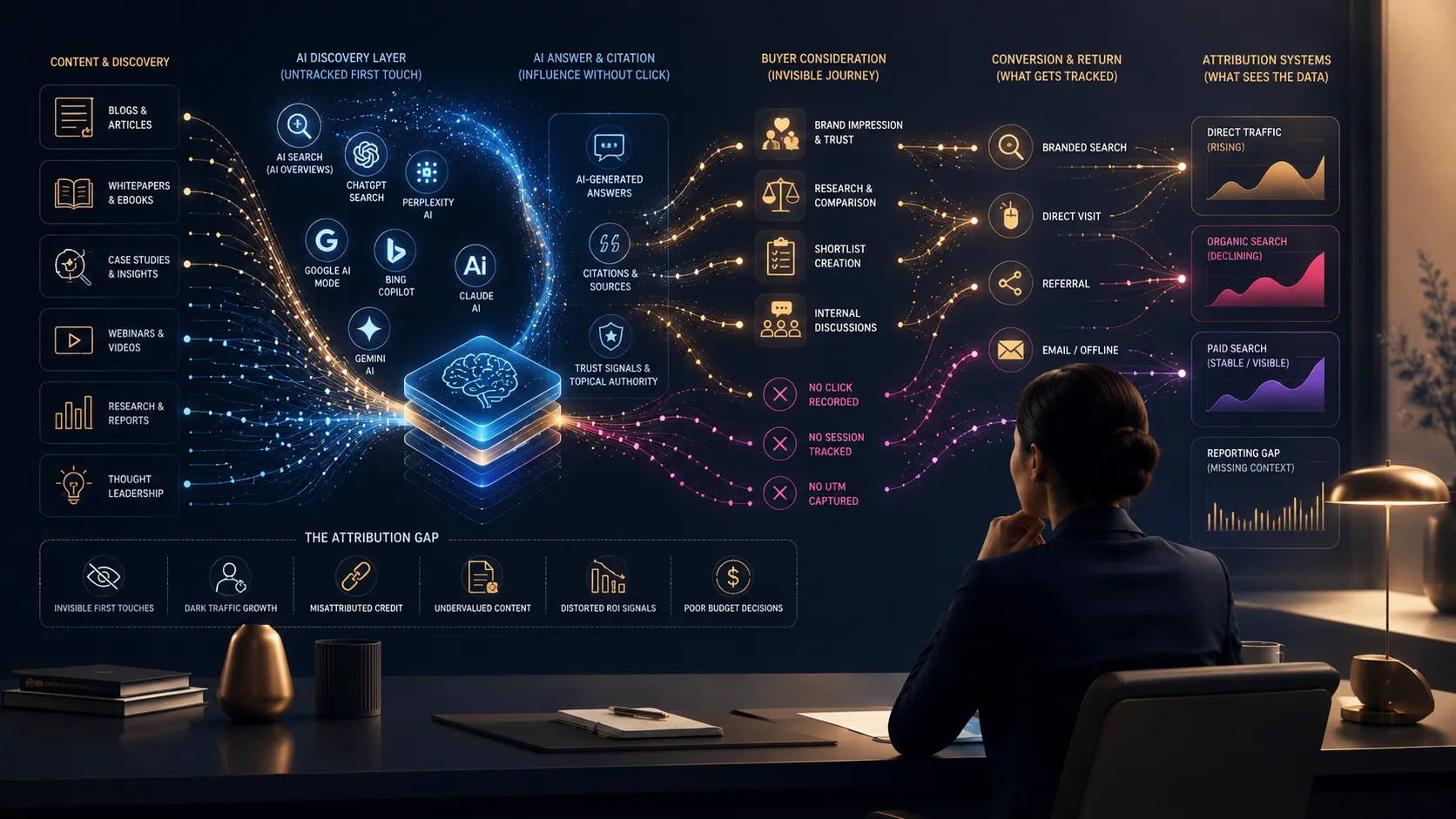
Why B2B Marketing Attribution is Broken in the AI Search Era
Google AI Overviews now respond to commercial queries without directing a single click to the source. That means the content earning your brand the most trust at the consideration stage is also the content that will never appear in your traffic reports.
B2B marketing attribution is becoming less reliable in 2026 because AI-powered search interfaces, including Google AI Overviews & AI Mode, ChatGPT Search, Perplexity, Claude, Gemini, and Bing Copilot resolve a growing proportion of commercial queries without directing users to source websites. When buyers discover brands through AI-generated answers and convert later via direct visits, attribution systems record the conversion as direct traffic, not content-driven.
The Invisible First Touch: How AI Search Broke Attribution Before You Noticed
When Google AI Overviews became the default response format for a significant proportion of commercial search queries in 2024, most B2B marketing teams registered the shift as a traffic story. Organic clicks were declining. The standard response was to note the trend, add an AI Overview monitoring task to the quarterly SEO review, and wait for the market to stabilise. At face value, that was a reasonable response to what looked like a channel-level disruption.
The attribution problem runs deeper than click loss. It is a structural break in the measurement chain itself, and the longer it goes unaddressed, the more distorted your understanding of content pipeline contribution becomes.
Consider what happens when a senior marketing director in Singapore searches for guidance on measuring content marketing ROI for B2B. An AI Overview responds with a synthesised, cited answer. If your content is among the sources, your brand has just earned a trust signal at the consideration stage. The buyer reads the response, forms an impression of which organisations are credible, and moves on. No click. No session recorded. No UTM parameter. Nothing in your analytics registers this as a marketing event.
Three days later, that same buyer types your brand name into a browser and arrives at your website. Google Analytics records this as a direct visit. Your attribution model assigns zero credit to the content that created the first impression, the AI citation that established authority, or the days of implicit consideration that preceded the visit. The channel doing the most work in your funnel is invisible to your reporting stack.
Where the Attribution Trail Goes Cold

AI search interfaces operate on citation logic rather than click-through logic. According to Google Search Central documentation on how AI Overviews work, these systems identify and synthesise content from authoritative sources and present it in the generated answer without requiring the user to visit the original page.
For brands that have invested in structured data, topical authority, and answer engine optimisation, this is a visibility win. Their content is being read and influencing decisions at exactly the right stage of the buyer journey. For their attribution systems, however, none of this is measurable without deliberate design. Understanding how to earn those citations in the first place is explored in depth in the LITV guide to generative engine optimisation and the companion post on how B2B brands in Singapore get cited in AI search.
Why Your Current Attribution Model Cannot See the Problem
B2B marketing attribution frameworks were built for a search environment where the discovery event and the tracking event happened simultaneously. A buyer searched a term, clicked a link, a session was recorded, and the channel was logged. Last-click attribution credited the final touchpoint before conversion. First-click models credited the discovery entry point. Multi-touch models distributed weighting across the journey. These approaches were imperfect, but they shared one structural assumption: the discovery event is a tracked event. In the AI search era, that assumption no longer holds.

The Last-Click and First-Click Blind Spots
When AI search resolves the discovery event without a click, both last-click and first-click attribution models fail in the same direction: they under-report the contribution of content and SEO to pipeline. Your CMO dashboard will show direct traffic increasing as a proportion of overall acquisition. Organic search will appear to contribute less. Paid channels may look disproportionately effective because they still generate tracked clicks. The measurement artefact, not the marketing reality is driving these trends.
Gartner’s forecast that traditional search engine volume will drop by 25% by 2026 is proving directionally accurate. Early 2026 search data and commentary from major analyst firms including Forrester confirm that click-through rates for top-ranking organic results have fallen sharply, particularly for discovery-stage queries that used to feed the top of the B2B funnel. For CMOs relying on traditional attribution models to justify content investment, the risk is not only missing credit for content performance. It is presenting a systematically distorted picture to the board — one that undervalues the channel doing the most consideration-stage work precisely at the moment when that work is hardest to replace.
The Singapore B2B Buyer Journey in the AI Search Era
Singapore B2B buying dynamics amplify this challenge considerably. The trust-first relationship dynamic that characterises purchasing decisions in Singapore and across APAC means the consideration stage is longer and more research-intensive than in comparable Western markets. A Singapore-based CMO evaluating a marketing partner will typically conduct multiple AI-assisted research sessions before forming a shortlist, well before any vendor knows they are being considered.
Forrester’s B2B Summit 2026 briefing describes this as a visibility vacuum: as research shifts into answer engines, marketers lose visibility into buyer questions, activity, and intent. The gap between AI-search-driven discovery and CRM-recorded first contact is not a minor measurement inconvenience. It is a fundamental mismatch between where trust is built and where your marketing system begins recording. For context on how senior marketing investment decisions are made in Singapore’s B2B landscape, that post is directly relevant here.
The Four-Signal Attribution Framework for the AI Search Era
Addressing AI-era attribution does not require replacing your analytics stack. It requires adding four measurement signals alongside your existing tracking to capture discovery events that happen before the click. These signals are directional indicators that, taken together, give a far more accurate picture of content pipeline contribution than any single-source attribution model.
Signal 1: Dark Traffic Baseline Audit
Dark traffic describes direct sessions that arrive with no referral source, no UTM parameter, and no identifiable entry point. Some proportion is genuinely direct — bookmarks, typed URLs, internal navigation. A growing proportion in 2026 is AI-influenced discovery: buyers who encountered your brand through an AI-generated answer and returned later as an apparently direct visitor.
Pull three to six months of direct traffic data and segment by new versus returning users, landing page depth, and behaviour flow. New users landing on blog posts or resource pages via a direct source are the primary indicator of AI-influenced discovery. The behaviour pattern is distinctive: they arrive on mid-funnel content without a conventional entry path, engage with depth, and often return. Establish this baseline before the next reporting cycle. Without a reference point, you cannot measure the growth of this segment over time, and you cannot build the case that it is growing because of content investment.
Signal 2: Branded Search Volume as a Discovery Proxy
When buyers encounter your brand in an AI-generated answer and find the content credible, a measurable proportion will later conduct a branded search to locate your website or verify your authority. This branded search volume is trackable in Google Search Console and functions as a proxy for AI-influenced brand awareness, even when no click was generated from the AI interface.
Track branded query impressions and click-through rates monthly alongside your AI citation monitoring. Rising branded search volume that correlates with increased content publication frequency or GEO improvements is a directional signal that your content is performing brand awareness work that standard analytics cannot record. As explored in the LITV analysis of how AI Overviews affect brand visibility, the brands most likely to capture this branded search uplift are those investing in topical authority and structured, citable content formats.
Signal 3: Direct Traffic Cohort Analysis
Rather than treating all direct traffic as an undifferentiated segment, conduct a cohort analysis comparing direct traffic behaviour before and after specific content publication events or GEO improvements. If a piece of content is published in week one and direct traffic from new users to that page category rises measurably in weeks two and three, this is an attribution signal even without a direct referral record.
This approach requires discipline in your publication calendar and analytics segmentation, but no additional tooling. Standard Google Analytics 4 cohort analysis, applied methodically across a 90-day attribution window, can surface these patterns reliably. The 90-day window matters particularly for B2B in Singapore and APAC, where enterprise consideration cycles regularly extend well beyond the 30-day windows that most attribution models default to.
Signal 4: Assisted Conversion Path Review
GA4 path exploration and multi-touch reports allow you to examine the full sequence of touchpoints preceding conversion, not only the last event. Reviewing assisted conversions — specifically the proportion of conversions where content-visited sessions appear anywhere in the path regardless of position — gives a more accurate read on content pipeline contribution than any single-click model.
In the AI search era, this signal is particularly valuable for identifying the sessions that follow an AI-search discovery event. Consider a buyer who encountered your brand in a Google AI Overview, conducted a branded search, arrived via organic, consumed two posts, and then converted via a direct session three days later. The last-click model records the direct session as the sole conversion driver. The assisted path review restores credit to every touchpoint across the sequence, giving you a materially more accurate picture of what actually moved the buyer from awareness to action.

Making the Case to Your Board Without Fabricating Numbers
Attribution conversations with boards fail when CMOs overclaim — attributing pipeline to content without sufficient signal strength — or underclaim — dismissing AI search contribution because it cannot be measured by conventional tools. Both positions damage credibility. The first overreaches. The second undersells the channel doing the most work at the consideration stage.
The four-signal framework gives you a defensible middle position: directional evidence from multiple measurement sources, not a single tracked number that may be misread. This is not a gap in your marketing performance. It is a gap in the industry’s measurement maturity, identified before the budget cycle rather than after it. For broader context on why simpler, strategy-led marketing systems make this argument easier to hold in 2026, that piece is worth reading alongside this framework.
McKinsey’s State of AI 2025 report documents the persistent challenge of linking AI activity to measurable business outcomes — noting that while 88% of organisations now use AI in at least one function, only a small cohort of high performers report EBIT impact at scale. The same measurement gap applies directly to AI-influenced marketing. CMOs who build defensible attribution frameworks now will be better positioned to argue for content investment as the industry’s measurement solutions catch up.
Final Conclusion: Measurement That Reflects How Buyers Actually Decide
Attribution has never been a fully solved problem in B2B marketing. The AI search era has made it considerably harder, but it has not made content investment less valuable. It has made the measurement of that value less visible through conventional tools. That distinction matters enormously when you are justifying content budget to a board that expects traceable returns.
The four-signal framework — dark traffic baseline audit, branded search volume proxy, direct traffic cohort analysis, and assisted conversion path review — does not produce perfect attribution. What it produces is a defensible, directional picture of content pipeline contribution that is far more accurate than a last-click model attributing all credit to the final recorded event and ignoring the implicit consideration that preceded it.For marketing leaders in Singapore and across APAC, where content investment competes for board budget against paid channels with cleaner tracking, building this measurement infrastructure now is a strategic advantage. The CMOs who can demonstrate that their content is earning AI citations, driving branded search growth, and influencing the dark traffic patterns that precede direct conversions are not describing a workaround. They are describing the only attribution framework that accurately reflects how B2B buyers actually make decisions in 2026. For those thinking beyond measurement toward the deeper trust architecture that makes AI-cited content possible, the LITV analysis of how brands build trust that compounds across AI-mediated buyer journeys is the natural next read.
Ready to audit your AI search visibility across ChatGPT, Perplexity, Google AI Overviews, Claude, Gemini, and Bing Copilot? The LITV AI SEO Agent 2.0 is built for B2B marketing teams that need AEO- and GEO-optimised content performing in both traditional search and AI discovery. Start your free access at seoagent.ladyintechverse.com.
Frequently Asked Questions (FAQ)
Internal Articles
- I Built an AI SEO Agent to Fix the Visibility Gap in AI Search
- The AI Productivity Paradox in 2025
- Agentic AI in 2025: Ripples that Signal the 2026 Workflow Tsunami
- How can CEOs use AI and Leadership to improve Crisis Communications in 2026?
- How Brands Build Human Trust in the Age of Agentic AI, Starting in 2026
- Digital Trust in 2025: Governance and Security Shaping the Next Economy
- Data Quality is the Power Move behind every winning AI Strategy in 2025
- Why more than 90% of AI Pilots Fail and How Hyper-Personalisation Wins
Sources Referenced
- Google Search Central — “How AI Overviews work,” developers.google.com, 2025.
- McKinsey and Company — “The State of AI in 2025: Agents, Innovation, and Transformation,” McKinsey Global Institute, late 2025.
- Gartner — Forecast: traditional search engine volume to decline 25% by 2026, Gartner Newsroom.
- Forrester Research — “Is AI Visibility Your 2026 Imperative?” B2B Summit North America 2026, Forrester.com, April 2026.
- Fast Company — “How AI Is Upending the B2B Marketing Funnel,” fastcompany.com, April 2026.
- OpenAI — ChatGPT Search product launch, October 2024.
Visual Content Disclaimer: All images in this post are AI-generated.
Why B2B Marketing Attribution is Broken in the AI Search Era
#LadyinTechverse #DigitalSanctuary #DigitalTransformation #MarketingTransformation #MarTech #B2BMarketing #MarketingAttribution #AISearch #GoogleAIOverviews #ContentMarketing #MarketingStrategy #MarketingROI #AIMarketing #MarketingAnalytics #DarkTrafficTracking #GenerativeAI #AttributionModelling


Leave a Reply