

Digital Trust in 2025: Governance and Security Shaping the Next Economy
[Author’s Note]
I want to be clear from the start: I am not a cybersecurity leader, not a DevSecOps engineer, and not a technical CISO. That’s not where my authority lies.
But what I do bring is a career built on digital strategy, corporate communications, external and internal messaging, B2B marketing and interactive advertising. These skillsets that translate technical systems into something that people understand, believe in, and act on.
Earlier in my career, I briefly worked in an IT department, shoulder-to-shoulder with security staff. Part of my role was handling server-level backup management and working closely with colleagues and vendor on IT security protocols. That gave me a practical and non-theoretical appreciation for what it means to protect systems and data at the ground level.
This blend of hands-on IT exposure and communications expertise is why I approach digital trust differently.
I do not just see it as compliance or technology, but as the story and strategy that connects those systems to people.

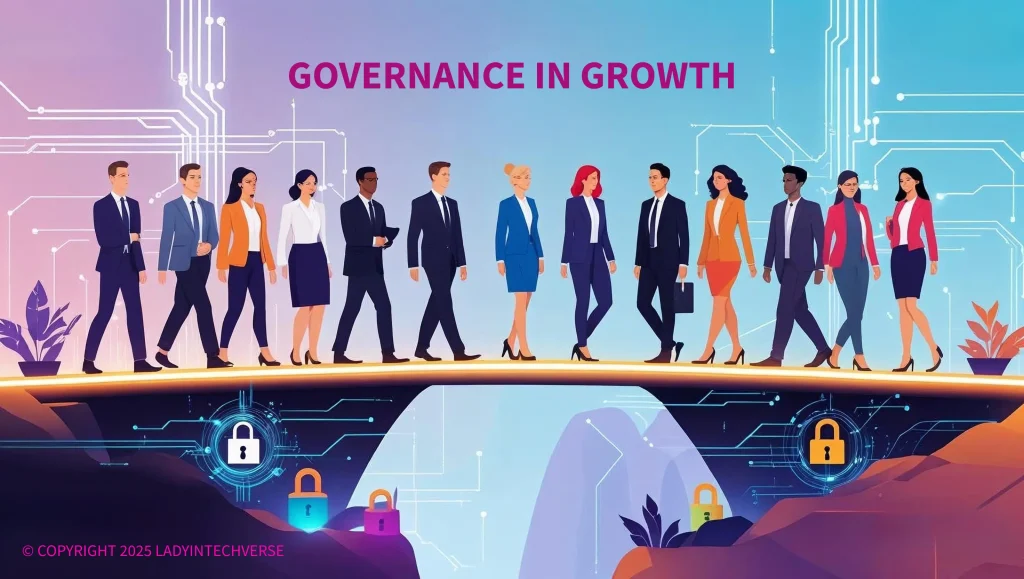
Without communications, even the most advanced accreditations or technical skills can end up like a standalone island with no bridges — isolated, unused, and disconnected from the cities of clients, employees, and partners who need to cross over and trust you.
– LadyinTechverse
The Big Trust Question that every Business faces in 2025
We’ve reached a point where trust is the real currency of digital economies.
It’s not just about who has the latest AI tool, or fastest, or fantastic UI SaaS platform. Clients, regulators, and end users now might ask:
- Can I trust this company with my data?
- Can I trust their governance processes to withstand scrutiny?
- Can I trust that promises aren’t just growth hype but backed by secure and ethical systems?
The companies that answer “yes” are the ones pulling ahead. Those who delay are already leaking employees’ and/or clients’ data, revenue, and reputation.
Trust isn’t a nice-to-have as it’s the only foundation that makes digital growth real.
Why Digital Trust is Reshaping the Next Economy
The 2025 economy is squeezed by a mix of increasing and shrinking budgets, rising interest rates, and cautious investors. Yet companies are still investing in digital transformation. Why?
It’s because trust is a growth multiplier.
- For SaaS companies: Without airtight security and compliance, enterprise clients won’t sign contracts no matter how innovative the product is.
- For FinTech: Regulators are sharpening their teeth – one slip in governance can wipe out years of credibility.
- For professional services: Clients demand transparency in delivery, reporting, and decision-making. Trust is the deal-breaker to chart the onboarding journey.
- For creative and digital consultancies: Being trusted partners in execution means you win repeat business over freelancers or cheaper agencies that overpromise project delivery.
The Four Pillars of Digital Trust in 2025
1. Governance that Scales
Boards and C-suites see governance as a growth enabler, not as a compliance checkbox. Transparent frameworks build confidence across investors, partners, and regulators.
Tip: Adopt board-level AI and security dashboards that track risks in real time.
2. Security as Business Continuity
Cyber threats are no longer sidelined as they’re a monthly boardroom concerns. Data breaches now directly correlate to client churn, revenue collapse and reputation risk.
3. Compliance as Competitive Advantage
From EU AI Act to Singapore’s PDPA updates, regulators are codifying standards. Companies that align early and position themselves avoid fines, while they win contracts faster because clients see lower risk.
4. Transparency that Wins Clients
Opaque systems are dying. Companies that show their working blueprints via explainable AI, clear reports, and transparent security measures are the ones landing renewals and upsells.

Why Communications and Marketing are the Golden Bridges of Digital Trust
Here’s the part where many C-level executives tend to overlook: trust doesn’t live only in certifications, audits, or cyber defences. Those are important foundations, but without communications and marketing, they’re like islands with no bridges — solid on their own, but disconnected from the wider economy.
Think about it in layman’s terms:
- You could have the best cybersecurity framework, ISO certifications, or compliance teams.
- But if your customers, employees, or stakeholders don’t understand what that means for them, then the effort is “invisible” and “intangible”. And this means “intangible” trust doesn’t convert into loyalty or growth.
This is where corporate communications (internal and external) and marketing capabilities step in as trust multipliers to align the company.
- Externally: Marketing and PR translate technical governance into clear human stories. They make certifications understandable and give credibility a voice that customers and stakeholders actually hear.
- Internally: Communications keep employees aligned, so they know how to act and speak consistently. If your internal teams don’t embody the trust you’re selling, credibility collapses at the first point of friction when customer-facing.
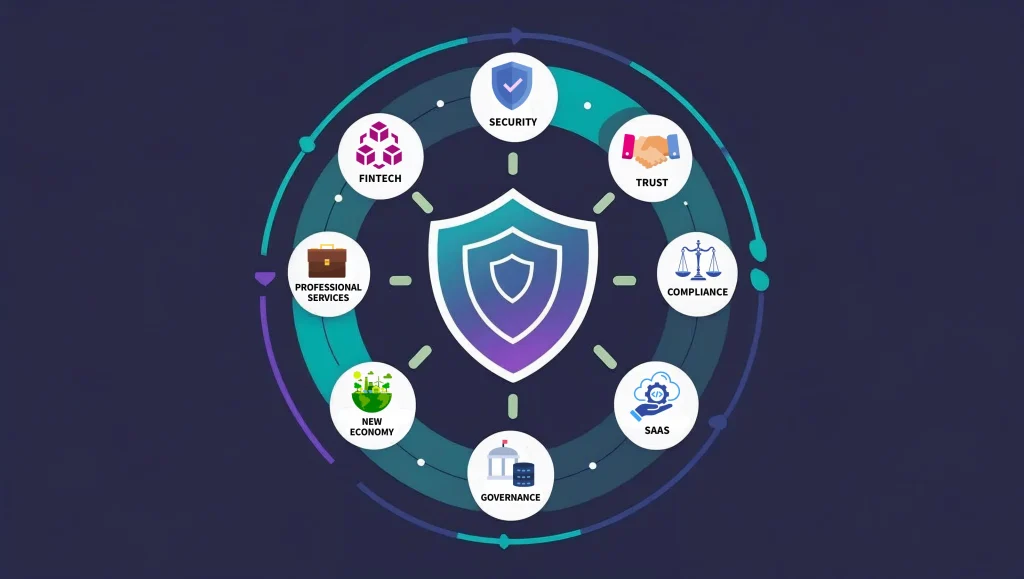
Digital trust in 2025 leads with Governance, Security and Communications to shape the Next Economy

In other words, Communications and Marketing are the bridges that connect your strong governance “islands” to the cities of clients, partners, and employees. Without those bridges, “digital trust” sits stranded, unused, and ineffective.
For SaaS, FinTech, professional services, and creative consultancies, this means:
- Accreditation alone won’t win contracts. Clear storytelling about why it matters will.
- Governance expertise won’t prevent churn unless internal comms empower frontline staff to deliver consistently enriching experiences to customers or clients.
- Security badges on a website won’t matter if marketing can’t position them as part of a transparent and customer-first narrative.
Digital trust isn’t just about foundational pillars and fundamental systems. It’s about the stories and signals that make people believe those systems are worth betting their future on.
– LadyinTechverse
What’s Brewing for 2026
Looking ahead, 2026 won’t be about adding tools. It will be about system-level trust.
- SaaS will evolve into compliance-first platforms.
- FinTech will integrate real-time regulatory monitoring into digital products.
- Professional services will rely on AI-driven trust reports to differentiate.
- Creative consultancies will pitch “secure by design” digital delivery as their edge.
Internal Links
- The B2B Reset: Why 2025 Belongs to Strategic Thinkers, Lean Tech, and Transparent AI
- Data Quality is the Power Move Behind Every Winning AI Strategy in 2025
The Trust Roadmap in 2025
- Audit Your Data Flows – Where is customer data stored, moved, and exposed?
- Map Governance Roles – Who is accountable? Who approves? Who monitors?
- Implement Security-by-Default – MFA, zero-trust, and encrypted pipelines.
- Make Transparency Routine – Regular client-facing trust reports.
- Test for Compliance Readiness – Run mock audits before regulators or clients do.
Why Solopreneurs should care
For one-person businesses, digital trust is leverage.
- It helps you land bigger contracts.
- It reassures small-to-medium businesses who are enterprise-ready-to-scale clients that you’re not a risk.
- It scales your reputation faster than ad spend ever could.
FAQ: Real Talk on Digital Trust
Q: Isn’t digital trust only relevant for Fortune 500s?
A: Not anymore. In 2025, SMEs and solopreneurs are under the same scrutiny as multinationals. A single data slip or vague contract can cost you enterprise deals. Trust is no longer scaled by company size — it’s scaled by how consistent and transparent your signals are.
Q: Isn’t building trust too expensive for lean teams?
A: The real cost isn’t in building trust — it’s in losing it. One breach, one compliance failure, or one misleading claim can burn through revenue faster than any security budget. Trust is the cheapest insurance policy you’ll ever buy.
Q: Won’t automation and AI make trust irrelevant?
A: Quite the opposite. The more workflows we hand to AI, the more clients demand human proof of integrity. AI without explainability feels like gambling; AI with human oversight feels like progress. Trust isn’t going away as it’s becoming the last differentiator.
Q: Can’t certifications and accreditations speak for themselves?
A: Only if someone translates them. A badge on a website is meaningless unless your communications and marketing show why it matters. Digital trust isn’t earned in the server room because it’s earned when clients, employees, and regulators understand your story.

Recommended Next Steps (30-day Checklist)
- Audit where your client or customer data sits.
- Add one new layer of security-by-default.
- Create a one-page client-facing trust report.
- Run a compliance readiness check against best industry benchmark standards in 2025.
- Document trust wins (client feedback and successful clean audits).
Final Word
Trust is and has always been the frontline of digital growth.
After 2025, businesses that weave governance, security, compliance, and communication into their DNA will be positioned for the next economy, where digital trust defines who thrives and who fades.
The next best companies won’t just be those with the best tools. They’ll be the ones clients and partners trust enough to bet their future on.
Sources Referenced:
- EU AI Act updates (2025)
- Monetary Authority of Singapore (MAS) governance advisories (2025)
- Gartner Digital Trust Framework (2024–2025)
- Forrester “Future of Trust in the Digital Economy” (2025)
- Harvard Business School, “Seven Trends to Watch in 2025” (2024)
Frequently Asked Questions (FAQ)
Internal Articles
- Data Quality is the Power Move behind every winning AI Strategy in 2025
- How Brands Build Human Trust in the Age of Agentic AI, Starting in 2026
- The B2B Reset: Why 2025 belongs to Strategic Thinkers, Lean Tech, and Transparent AI
- The MarTech Wake-Up Call: Why Marketing Needs Fewer Tools and Clearer Strategy in 2026
- The AI Productivity Paradox 2025
- How can CEOs use AI and Leadership to improve Crisis Communications in 2026?
- Digital Decluttering for Mental Wellness with a Proven System
Visual Content Disclaimer: All images in this post are AI-generated.
Digital Trust in 2025: Governance and Security Shaping the Next Economy
#LadyinTechverse #DigitalTrust #Cybersecurity2025 #Governance #DataSecurity #SaaS #Fintech #ProfessionalServices #DigitalTransformation


Leave a Reply