

One of the most valuable B2B marketing assets in 2026 is not content, not search ranking, and not share of voice in AI search. It is the email address in your CRM that belongs to someone who chose to hear from you directly.
AI search engines, including Google AI Mode, Perplexity, and ChatGPT Search, now answer commercial buyer queries at the point of search, eliminating the website visit that previously served as the entry point for B2B lead capture. First-party data assets, specifically email subscribers, CRM contacts, and direct community members are structurally immune to this interception and represent the only reliable acquisition infrastructure for B2B growth in 2026.
The Acquisition Layer AI Search has already Removed
Most B2B marketing leaders are treating AI search erosion as a visibility problem. The framing is understandable: if fewer buyers are clicking through from Google to your site, the obvious conclusion is that you need to appear more prominently in AI-generated answers. This reasoning is not wrong. It is incomplete, and the gap between “not wrong” and “complete” is where demand generation strategies are currently failing.
The mechanism deserves precise examination. When a B2B buyer types a commercial query, such as “best demand generation platforms for mid-market SaaS” or “how to evaluate a fractional C-Suite,” Google AI Mode now synthesises an answer from multiple sources, presents it conversationally, and resolves the query. The buyer gets what they came for. The website that previously captured their email address via a gated asset never appears in the journey at all. This is not primarily an SEO problem. The content may be cited. The brand may receive an attribution signal. But the acquisition event, the moment when a buyer exchanges contact information for value, does not happen.
Google AI Mode reached one billion queries in 2025 and is expanding its commercial query coverage continuously. Perplexity AI and ChatGPT Search are adding millions of monthly active users across commercially oriented query types. The combined effect on B2B marketing is structural rather than cyclical: organic search traffic to B2B content sites is declining as a lead acquisition source in direct proportion to AI search adoption, and no amount of AEO or GEO optimisation fully restores the acquisition event that AI interception removes.
Understanding this distinction is what separates a tactical SEO response from a strategic marketing architecture decision.
Where the Zero-Click Impact Hits

The most direct impact of zero-click AI search is not on brand awareness or content reach. It is on the email capture mechanism. The typical B2B top-of-funnel journey relied on a specific sequence: organic search brings a buyer to a piece of educational content, that content creates enough trust and relevance to motivate an email capture action, whether a newsletter sign-up, a gated asset download, or an event registration, and that email address enters a nurture sequence that eventually converts to a sales conversation. AI search interrupts this sequence at the first step. The buyer receives the educational content from the AI interface without visiting the site. The email capture never occurs, and the nurture sequence never starts.
For B2B marketing leaders who have built pipeline models that depend on organic search as the top-of-funnel volume driver, this is not a future risk to monitor. It is a current structural erosion that compounds with each quarter of AI search adoption growth. The attribution challenge this creates is documented separately, but the acquisition architecture problem is the upstream issue that must be addressed first.
Why This is Structural, Not Cyclical
Search behaviour has changed multiple times before. SEO has absorbed every algorithm update, featured snippet expansion, and SERP redesign over two decades. The reasonable question is whether AI search erosion represents another temporary setback the industry will adapt to, or a categorical change in how search products are built.
The answer lies in the incentive structure. Google, Perplexity, and ChatGPT Search all improve their products by resolving user queries completely within their own interfaces. Every improvement to AI answer quality reduces the need for the user to click through to an external source. The product roadmap of every AI search engine is by design, oriented away from sending traffic to external websites. This is not a bug that will be patched, since it is a competitive direction of a product category. B2B marketing leaders who are waiting for AI search to settle down before making structural decisions about their acquisition model are waiting for a change that is not coming, probably will be more fragmented than when we had this in 2025.
The First-Party Data Advantage in a Zero-Click World
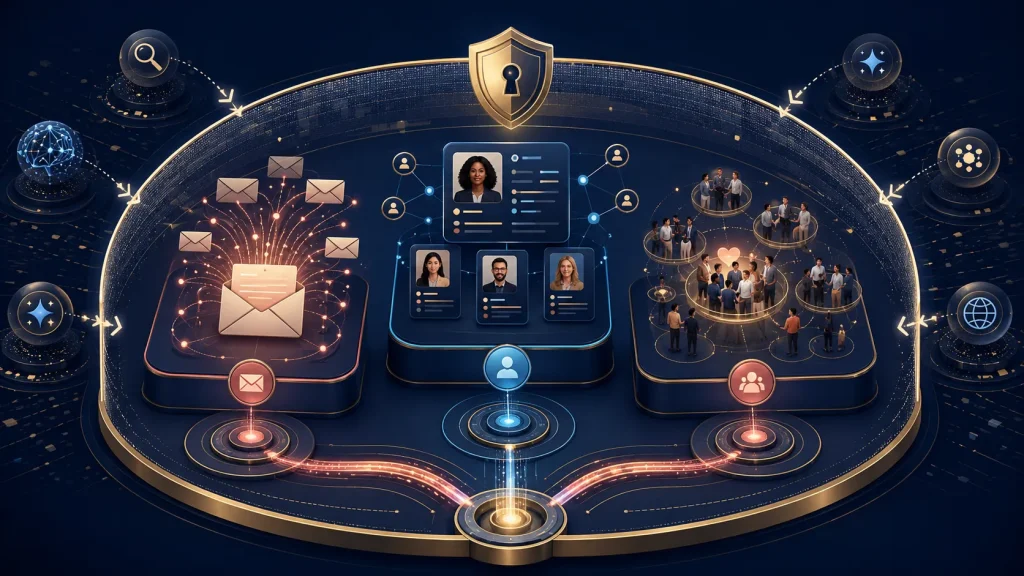
First-party data, specifically the contact records, engagement histories, and preference signals that live in your CRM and email marketing platform is immune to AI search interception by definition. An AI search engine cannot answer a query on behalf of your newsletter subscriber. It cannot intercept the email you send to someone who signed up to receive it. It cannot disintermediate a direct conversation between your sales team and a warm contact in your CRM. This immunity is not a minor advantage. In an environment where the primary organic acquisition channel is being structurally compromised, it is the most significant structural advantage a B2B marketing function can hold onto.
The strategic implication is direct: B2B marketing leaders who accelerate owned audience acquisition now, before the AI search erosion compounds further are building infrastructure that becomes more competitively differentiated with every quarter that passes. Understanding how Google AI Mode and AI Overviews behave differently informs content architecture decisions, but owned audience infrastructure is the layer that sits above those optimisations and is unaffected by them.
What “Immune to AI Interception” Means in Practice
The immunity claim requires precise grounding. First-party data assets are immune in the sense that the delivery mechanism, direct email, CRM contact sequence, or community membership is fully controlled by the brand. An AI search engine cannot intercept an email you send to a subscriber who has opted in. It cannot redirect a sales cadence that originates from a CRM workflow. It cannot answer the question that a community member posts directly inside your owned platform. These are direct-channel interactions that bypass search entirely.
What first-party data is not immune to is discovery. New buyers still need to find you before they can become subscribers or CRM contacts. This is where AEO and GEO optimisation remain relevant, not as the primary acquisition strategy, but as the discovery layer that feeds the owned audience engine. The strategic error most B2B marketing leaders are making is treating AEO and GEO as the destination rather than the onramp. The goal is converting AI-driven discovery into an owned contact relationship before the next AI search intercepts the next query from the same buyer.
The Three Assets that Cannot be Disintermediated

When evaluating first-party data infrastructure, three asset types consistently demonstrate immunity to AI search erosion: the opted-in email subscriber list, the structured CRM contact record with enriched engagement history, and the active direct community membership. These three are not interchangeable. Each operates at a different point in the buyer relationship and requires a different investment profile to build. But they share the critical property that the relationship exists between the brand and the buyer directly, with no intermediary platform that can be algorithmically altered or commercially redirected to intercept the interaction.
Email subscriber lists maintain their ROI advantage in every annual channel study conducted by Litmus, Mailchimp, and the Data and Marketing Association. As relevant it can be for 2026 planning, they are the one B2B marketing asset whose performance is completely unaffected by what Google, Perplexity, ChatGPT, Claude, Bing Copilot or any AI search engine does with their product. A subscriber who receives your newsletter is not waiting for Google AI Mode to answer the same question. They are reading what you wrote because they made a deliberate choice to stay in a direct relationship with your service and/or product.
Why B2B Marketing Leaders are Solving the Wrong Problem
The dominant response to AI search erosion among B2B marketing leaders has been to invest in answer engine optimisation and generative engine optimisation. This is a rational response towards the existing AI search crisis, whereby available setups involving AEO and GEO investment produces measurable outcomes: brand citations in AI answers, improved entity recognition, and structured data signals that increase the likelihood of appearing in AI-generated responses. These are real and valuable outcomes, however, the problem is the strategic frame sitting behind the investment decision.
When a B2B marketing leader positions AEO as the primary response to AI search erosion, they are implicitly accepting that organic search traffic, even AI-mediated organic search traffic will remain the primary top-of-funnel acquisition mechanism. They are optimising the existing acquisition architecture rather than building a parallel architecture that does not depend on third-party platform behaviour. This is the wrong layer to optimise in isolation.
AEO and GEO remain important as visibility tactics, but when treated as a strategic response rather than a supporting tactical layer, they address the symptom without resolving the underlying vulnerability.
– Fahiza s. / ladyintechverse
The Structural Vulnerability that AEO Alone Cannot Fix
The structural vulnerability is direct: a B2B marketing function that depends on any third-party platform, whether Google, LinkedIn, or an AI search engine for its primary acquisition volume is exposed to the product and business decisions of that platform. Google can change its AI answer quality and reduce citation volume. Perplexity can change its monetisation model and begin deprioritising organic citations in favour of sponsored answers. LinkedIn can change its algorithm and reduce organic content reach. When any of these platform decisions change, the B2B marketing function’s acquisition pipeline is affected regardless of how well-optimised the content is.
Owned audience infrastructure does not eliminate platform dependence for discovery. But it shifts the critical dependency point. Once a buyer has joined your newsletter, entered your CRM through a direct engagement, or become an active member of your community, the ongoing relationship is owned. Platform algorithm changes affect your ability to find new subscribers. They have no effect on your ability to communicate with existing ones. This is the difference between a fragile acquisition model and a resilient one.
Building Owned Audience Infrastructure: What It Takes
The practical challenge for most B2B marketing leaders is that owned audience infrastructure takes longer to build than organic search traffic. An SEO investment can produce measurable traffic within three to six months. An email subscriber list built on genuine opt-in requires more time and a more sustained content commitment because the subscriber is at the ‘consideration stage with several levels of stack information’ before making a choice over a search click. This timeline difference is precisely why the investment needs to begin now, before AI search erosion compounds further, rather than after the traffic decline has already affected pipeline volume.
The operational components of owned audience infrastructure are not complex, but they require deliberate architecture setup. The email programme needs a clear reason to subscribe that is distinct from “sign up for updates” and that delivers specific, repeatable value on a predictable schedule. The CRM layer needs enrichment fields that capture intent signals beyond contact details, including content interaction history, event attendance, and asset downloads, so that the contact record tells a story about buyer readiness rather than simply confirming existence. The community layer, whether a whitepaper publication, a LinkedIn newsletter, or a proprietary platform, needs a defined content cadence and a clear editorial identity that makes continued membership worth the subscriber’s attention cost.
None of this is conceptually new. What is new is the strategic urgency. Building owned audience infrastructure has always been a sound B2B marketing practice. What AI search erosion has done is change the cost of not building it. In 2023, a B2B marketing function that relied primarily on organic search traffic was missing an opportunity to build resilience. In 2026, the same function is operating with a structurally compromised acquisition layer that will continue to erode as AI search adoption grows.
My Personal Anecdote: Nothing is Conceptually New from a Practitioner’s Perspective when building CRMs before the AI Search wave, erosion and dominance
Once I helped setup, organise and build a client’s CRM system to enrich and nurture its sequences because it was the only way that digitalisation timeline allowed this to happen. I could have pushed for pure content magic: biweekly or monthly enewsletters, digests, useful guides and more, but the client insisted on the email sequences only. Although there was a budget-constraint for content production, it was still possible to generate it at a cheaper cost and this was before GenAI came into the creative landscape.
Imagine buying your expensive smartphone – an iPhone or an Android phone but it functions like similar to a Nothing phone with basic call functions, SMS, WhatsApp, Contact Book and a Browser. As frustrated and annoyed I was, I came to this conclusion – I will never organise or build a system for basic people’s needs ever again. Not only this ruined my portfolio; it made me think that my client cannot be this ****. Since then, I refused to accept such project briefs but because it was a favour for a friend’s contact, I had no choice.
Final Thoughts: The Bottom Line
AI search erosion is not a visibility problem. It is an acquisition architecture problem. The B2B marketing leaders who will hold competitive ground in 2026 and beyond are not the ones who appear most frequently in AI-generated answers. They are the ones who have built owned audience infrastructure that cannot be disintermediated, regardless of how AI search products evolve. Consider this as your ace plan, above traditional organic search and AI search because web and digital traffic is very fragmented now, until you cannot match an apple for an apple ideally anymore.
The question is not whether to build more of them. The question is how quickly you begin, and whether you start before the AI search erosion reaches the pipeline volume that finally makes the urgency undeniable.
If you are ready to audit your content architecture for AI search visibility and owned audience capture in one workflow, the LITV AI SEO Agent is still available now. It surfaces the exact gaps between your current content structure and what AI search systems need to cite you, so you can invest with precision rather than assumption with the context trees.
Frequently Asked Questions (FAQ)
Internal Articles
- MarTech Stack Rationalisation: What AI-Native CRMs Mean for APAC B2B
- LLM SEO Training Data vs AI Retrieval: The B2B Visibility Gap
- Machine-Readable Authority: How AI Systems Decide Who To Recommend
- Why Some MarTech Stacks Still Cannot Talk To Your AI Agents in 2026
- Ungoverned MarTech: The Hidden Compliance Risk Behind AI-Built Tools
- Why B2B Marketing Attribution is Broken in the AI Search Era
- Marketing AI Readiness: How to Prepare Your B2B Team for Agentic AI
- AI Hallucination Brand Risk in Zero-Click World: The B2B Marketer’s Verification Guide for 2026
- Why B2B Marketing Attribution is Broken in the AI Search Era
- Marketing AI Readiness: How to Prepare Your B2B Team for Agentic AI
- Generative Engine Optimisation: How to Get Cited by AI in 2026
- Answer Engine Optimisation: How B2B Brands in Singapore Get Cited in AI Search in 2026
- Synthetic Content, AI Influencers and the Fight for Authenticity in Marketing
- What is Retrieval-Augmented Generation (RAG)? A Business Guide to AI that Knows Your Data
- I Built an AI SEO Agent to Fix the Visibility Gap in AI Search
- Personal Brand Authority in 2026: The One Asset AI Cannot Copy
- Vibe Coding is Rewriting Digital Services: What Agencies, SaaS, and Marketers Must Do Next
- AI Coding Tools 2026 – How to Choose the Right One for Your Workflow
- Why Internal Linking is the Most Underrated SEO Strategy You are Probably Ignoring
- The AI Productivity Paradox in 2025
- Agentic AI in 2025: Ripples that Signal the 2026 Workflow Tsunami
- How can CEOs use AI and Leadership to improve Crisis Communications in 2026?
- How Brands Build Human Trust in the Age of Agentic AI, Starting in 2026
- Digital Trust in 2025: Governance and Security Shaping the Next Economy
- Data Quality is the Power Move behind every winning AI Strategy in 2025
Sources Referenced
- Google — Google AI Mode: Answering More Complex Questions — Google Blog — 2025
- Perplexity AI — Product and Growth Updates — Perplexity Blog — 2025-2026
- Litmus — State of Email Report — Litmus Research — 2025
- Gartner — Gartner Predicts Search Volume Will Drop 25% by 2026 Due to AI Chatbots and Virtual Agents — Gartner Newsroom — February 2024
Visual Content Disclaimer: All images in this post are AI-generated.
The First-Party Data Imperative: Owned Audiences in the AI Search Era
#LadyinTechverse #DigitalSanctuary #DigitalTransformation #MarketingTransformation #MarTech #firstpartydatamarketing #ownedintelligence #aimarketing #b2bmarketing #zeroclickmarketing #emailmarketing #demandgeneration #firstpartydata #aimarketingstrategy #b2bcmostrategy #ownedaudiencemarketing


Leave a Reply