
Why Internal Linking is the Most Underrated SEO Strategy You are Probably Ignoring
Internal linking is the only SEO strategy that costs nothing, takes under an hour to implement, and immediately improves how both Google and AI search engines understand every post on your site. Here is exactly how to do it.
You have spent months publishing quality content. Google still is not ranking it. The reason might have nothing to do with your keywords, your domain age or an anomaly that is not easy to identify. It might be something far simpler, and far more fixable.
Most content strategies obsess over the external: backlinks from high-authority sites, keyword rankings on Google’s first page, domain authority scores that shift up and down like a stock market. All of that matters, but it is only about half the picture. The other half sits entirely within your own website, under your full control, and costs you nothing except a bit of strategic thinking. That is internal linking, and if you are running a blog or a content-heavy site without a deliberate internal linking strategy, you are quite literally leaving search equity on the table.
This is not a beginner’s tip dressed up in strategic language. It is a foundational SEO layer that mid-sized content operations consistently overlook, not because they do not know it exists, but because it feels less glamorous than chasing backlinks or refreshing keyword rankings. That oversight is quietly costing your rankings every single day.
What Internal Linking Means and What It Does Not
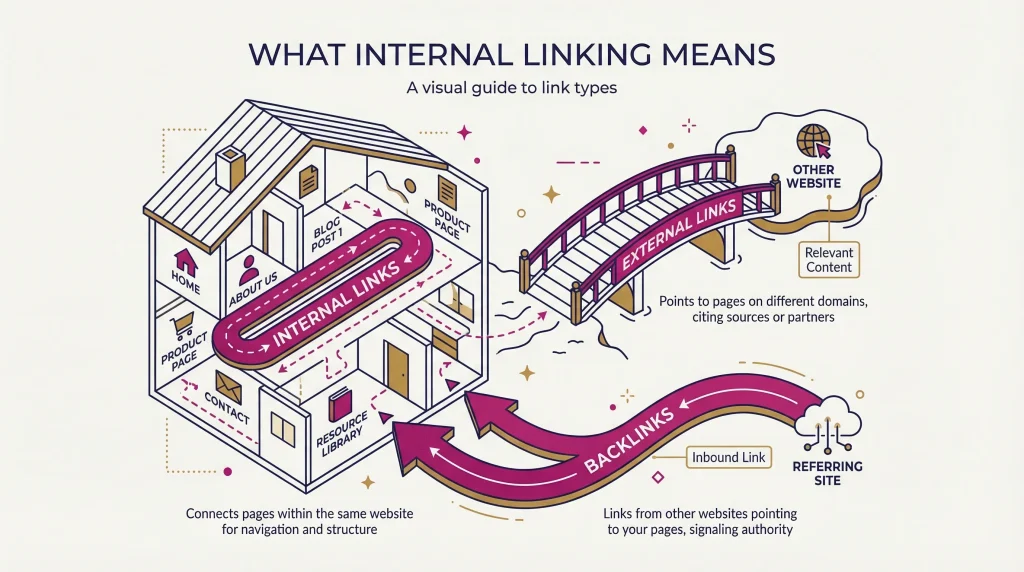
An internal link is a hyperlink from one page on your website to another page on the same website. When you write a blog post or an article, and link to a previous article you published, that is an internal link. When your navigation menu links to your About page, that too is an internal link. The mechanics are entirely straightforward. The strategy behind them is where most site owners fall short.
The Difference Between Internal Links, External Links, and Backlinks
Let me be precise about the terminology because these three things are regularly conflated. An internal link connects two pages within the same domain. An external link goes from your site to a page on a different domain. A backlink is an external link pointing to your site from someone else’s domain.
Backlinks have historically received the most attention in SEO conversations because they carry off-page authority. When high-quality sites link to your content, they are effectively vouching for your credibility in Google’s eyes. That matters enormously. But here is the thing: internal links are the mechanism through which you distribute that hard-earned backlink authority across your own site. If all your external links point to your homepage but none of that equity flows to your deeper content pages through internal linking, your supporting posts remain in relative obscurity regardless of how authoritative your domain is.
Why Google Cares About Your Site’s Link Architecture
Google discovers new pages and re-crawls existing ones primarily by following links. Googlebot, the crawler that indexes the web, navigates your site the same way a methodical reader might: it follows every hyperlink it can find and maps what is connected to what. If a page on your site has no internal links pointing to it, Googlebot may never find it at all, regardless of how well-written or keyword-optimised that page happens to be. These are called orphaned pages, and they are a far more common problem than most site owners realise.
Beyond discovery, your site’s link structure also communicates hierarchy. A page that has many internal links pointing to it signals to Google that it is an important, high-value resource within your site’s ecosystem. This directly influences how that page is treated in terms of crawl priority and ranking potential. The architecture of your site, as expressed through its links, is a signal in itself.
The Real SEO Value of Internal Linking in 2026
The SEO value of internal linking extends well beyond just helping Google’s crawler find your pages. In 2026, as AI-powered search engines play an increasingly prominent role in how audiences discover content, the strategic interconnection of your posts carries even more weight than it did in the era of purely algorithmic search.
PageRank Flow and Link Equity: the Non-Technical Explanation
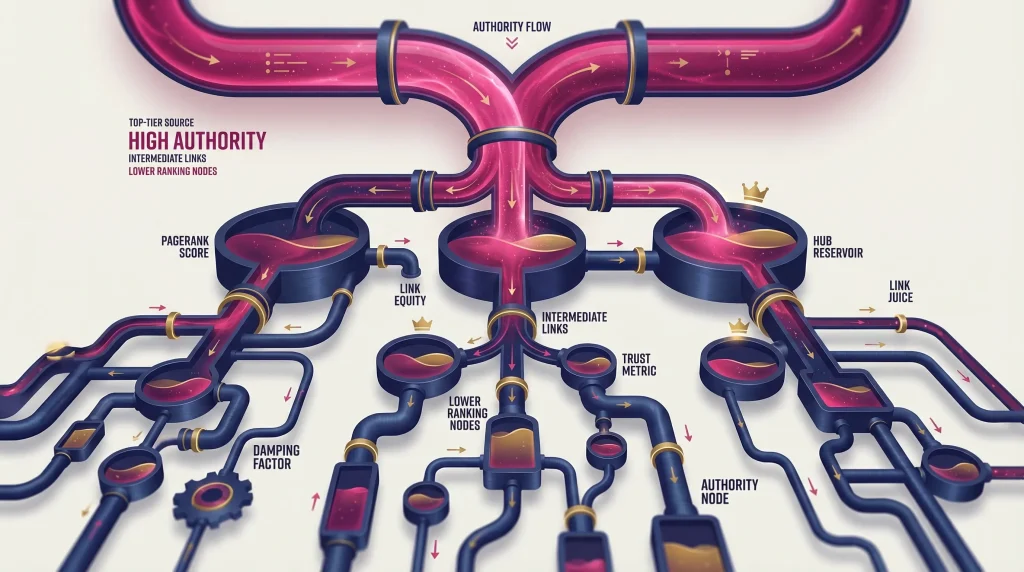
PageRank, Google’s original ranking algorithm, operates on the principle that a link is a vote of confidence. Pages that receive more links from other well-linked pages accumulate more authority, and that authority influences search rankings. While Google’s algorithm has evolved considerably since PageRank was first introduced, the underlying logic of link equity still applies. Internal links pass a portion of a page’s authority to the pages they link to, which means that when one of your high-traffic or high-authority pages links to a newer or lower-ranked post, that newer post benefits from the association.
Think of it as credit flowing through a network. Your most authoritative pages act as distribution hubs. The internal links from those pages channel authority to content that might otherwise struggle to gain traction on its own. This is not a magic fix. It is a compounding advantage that builds over time as your content library grows and your internal architecture becomes more deliberate.
How Internal Linking Signals Topical Authority to AI Search Engines
In the current search landscape, topical authority matters as much as individual page authority. Google and AI-powered search tools such as Perplexity and ChatGPT’s browsing feature evaluate not just whether a page answers a query, but whether the site it comes from demonstrates genuine depth and breadth of knowledge on the subject. A blog with fifteen posts on AI strategy that are all well-linked to each other will rank with far more confidence than a blog with the same fifteen posts that exist as isolated, disconnected pages.
Internal linking is one of the primary signals through which search engines assess this topical coherence. When your posts about SEO strategy link to your posts about technical SEO, Generative Engine Optimisation (GEO), Answer Engine Optimisation (AEO), and content marketing, you are building a semantic map that tells search engines this site knows what it is talking about, and that these topics belong together in a meaningful way.
What LLM-Based Search Engines Look for in a Well-Linked Site
Large language models used in AI search tools are trained on vast quantities of web content. Well-linked and well-structured sites tend to appear more frequently within that training data because they are easier to crawl, more often referenced by other sources, and more coherent in their topical coverage. The practical implication is consistent with traditional SEO logic. A site that is internally coherent and well-organised is more likely to be treated as authoritative by both classic search algorithms, AI bots and generative AI tools. This has direct implications for how AI Overviews are affecting organic search visibility and how brands maintain discoverability in a search landscape that is increasingly shaped by AI-generated responses.
How to Build an Internal Linking Strategy that Works
Understanding why internal linking matters is one half of the equation. The other is knowing how to build a strategy that delivers results without becoming a full-time administrative project.

Internal Linking Audit: Which Tool Actually Helps?
Six tools compared on the one thing that matters here: how well they help you audit,
identify, and fix your internal linking architecture.
| Internal Linking Audit Feature | Best Value LITV AI SEO Agent seoagent.ladyintechverse.com | Screaming Frog Desktop app – Free (500 URLs) | Google Search Console Free – always on | Link Whisper WordPress plugin – Paid | Ahrefs / Semrush Enterprise platforms – Paid |
|---|---|---|---|---|---|
| Free Tier Available Can you start without paying? | ✓ Unlimited daily audits Unlimited audits per day, no login required | ⊖ Free up to 500 URLs only; larger sites need paid licence | ✓ Free but internal link reporting is very limited | ✕ Paid only; no free tier | ✕ Ahrefs: paid only. Semrush: 100 URLs/month on free plan |
| Orphaned Page Detection Flags content with zero internal links pointing to it | ✓ Flagged in Technical SEO audit Crawlability issues surface pages with no internal link pathways; included in scored Technical SEO pillar | ✓ Clear orphan report generated per crawl; URL-level precision | ⊖ Coverage report surfaces some discovery issues; not labelled as orphaned pages specifically | ⊖ Flags low-link-count pages; not a dedicated orphan audit | ✓ Full orphan detection with crawl priority scoring; industry-leading depth |
| Broken Internal Link Detection Identifies internal links returning 404 or redirect errors | ✓ Included in Technical SEO scored audit Broken links and redirect issues surfaced as part of crawlability and site health scoring | ✓ All 404s and redirect chains flagged per crawl with full URL list | ⊖ 404 errors visible in Coverage tab; no dedicated internal link error view | ✕ Not a broken link checker; focused on suggestions, not error detection | ✓ Broken link audit with fix prioritisation; full site-wide view |
| Crawlability and Architecture Scoring Scores how well search engines can navigate your internal link structure | ✓ Scored pillar output Technical SEO pillar includes crawlability, robots, schema, sitemap, and internal link architecture as a composite score with severity ranking | ⊖ Produces crawl data but does not score architecture; raw data only | ⊖ Page Experience signals available; no architecture scoring | ✕ Not a crawl or architecture tool | ✓ Full site health scoring including link architecture; paid plans only |
| Actionable Fix Recommendations Tells you exactly what to fix and in what order | ✓ Severity-ranked Fix Pack Paid plans deliver a full Fix Pack PDF to your inbox: severity-ranked, with fix times and expected outcomes per issue. Not just a data dump. | ⊖ Surfaces issues but does not prioritise fixes or estimate impact | ⊖ Suggests fixes via Search Console documentation; no severity ranking | ⊖ Makes link suggestions but does not diagnose existing architecture problems | ⊖ Recommendations available in paid tiers; no bundled Fix Pack format with fix time estimates |
| PDF Report Delivered to Inbox Downloadable, shareable audit output | ✓ Full 4-framework PDF + Fix Pack Paid plans only. Full Technical SEO, SXO, GEO, and AEO report delivered to inbox with Fix Pack bundled | ✕ Data export available but no formatted PDF report | ✕ No PDF export | ✕ No PDF report output | ⊖ Ahrefs: via My Reports, schedulable. Semrush: PDF export on paid plans. Neither delivers a Fix Pack. |
| APAC and Singapore Context Built with APAC markets, PDPA, and regional SEO in mind | ✓ Purpose-built for APAC, UK, and EU GDPR and UK GDPR compliance stated on product page. Singapore PDPA context applied throughout. Not a repurposed global tool. | ⊖ Global tool; no regional SEO context or compliance framing | ⊖ Global platform; regional intent not addressed in tooling | ✕ US-centric product; no APAC focus | ⊖ Global platforms with multi-region support; not purpose-built for APAC or Singapore market context |
| Entry Price Minimum cost to access meaningful audit data | $7/mo or $75/yr Free daily audit included. Paid plans unlock Fix Pack, PDF delivery, and annual beta access to AVYSTRAL.AI | Free (up to 500 URLs) Paid licence required for larger sites | Free Limited internal link data at no cost | From ~$77/yr WordPress only; suggestions-focused, not audit-focused | $99-$299/mo Ahrefs from $129/mo. Semrush from $99/mo. Significant monthly commitment. |
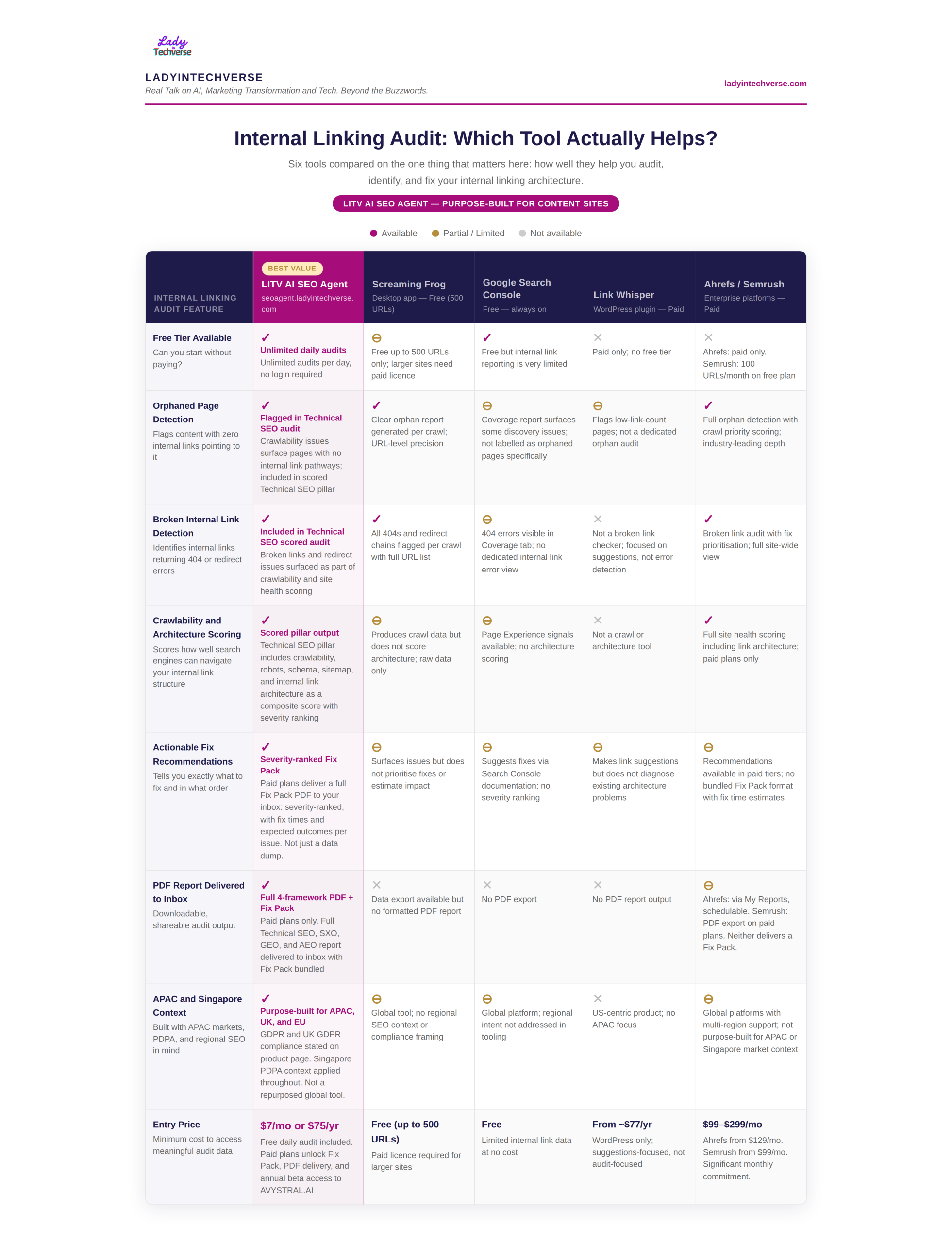
Source Table Referenced: https://seoagent.ladyintechverse.com/compare
Start with a Content Audit BEFORE You Add a Single Link and Adding content structure to be cited by AI
The most common mistake is to start adding links reactively, dropping references into older posts without a clear picture of how your content is currently connected. Before you touch a single post, pull a list of all the content currently published on your site and map it out. You are looking for two things: pages with no internal links pointing to them (orphaned pages), and pages with a disproportionately high internal link count compared to their actual SEO contribution.
A quick site crawl with a tool like Screaming Frog or Ahrefs Site Audit will give you this picture within minutes. Google Search Console can also surface crawl issues related to orphaned pages, though its internal linking reporting is less granular than dedicated SEO tools. Once you have that map, you can make deliberate decisions about which pages need more internal link support and which pages are strong enough to act as link sources for weaker content.
The Pillar-Cluster Model and Why It Matters for Your Blog
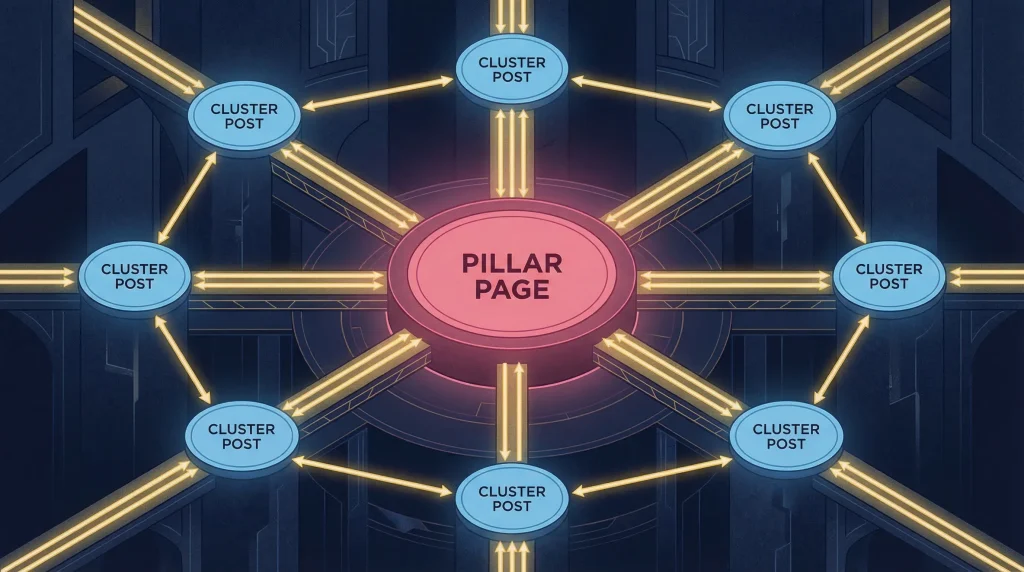
The pillar-cluster model is one of the most well-documented content architecture strategies in modern SEO, and it translates directly into an internal linking framework. A pillar page covers a broad topic comprehensively, while cluster pages go deep on specific subtopics that relate back to the pillar. Every cluster page links to the pillar, and the pillar links out to each cluster, creating a tightly interconnected hub-and-spoke structure that signals topical authority clearly to search engines.
For a digital innovation and marketing site, a pillar page on AI and digital transformation would link out to cluster posts on AI Overviews in search, agentic AI workflows, why your MarTech stack needs fewer tools and clearer strategy, and the rewriting of digital services through new development approaches, all of which in turn link back to the pillar. Each post reinforces the others, and the entire cluster benefits from any authoritative backlinks the pillar accumulates over time.
Anchor Text Best Practices, and What to Avoid
The text you use to hyperlink matters more than most people think. Descriptive, contextual anchor text, where the linked words actually describe what the reader will find on the destination page, is significantly more useful to search engines than generic phrases like “click here” or “read more”. If you are linking to an article about the future of search and AI-generated responses, anchor text like “how voice, visual, and AI are reshaping search experiences” is both informative for the reader and semantically rich for the search engine, something you can see in action across the future of digital marketing in 2025 and beyond.
What to avoid: stuffing your anchor text with exact-match keyword phrases in every link, as this looks unnatural and can attract algorithmic scrutiny. Vary your anchor text naturally across multiple links to the same page, using different but related phrases that reflect how people actually search for that topic.
How Many Internal Links Per Post is Enough
There is no hard rule here, and anyone telling you there is a magic number is oversimplifying a nuanced topic. The right number depends on the length of the post, the depth of your content library, and the natural opportunities that arise within the text. As a practical guide, a post of 1,500 to 2,000 words should comfortably support between three and seven contextual internal links. These should feel natural within the reading experience, not forced into place to hit an arbitrary quota. If you find yourself adding a link purely to meet a number, that is a signal you need more supporting content in your library rather than more links within a single post.
Internal Linking for WordPress Blogs: A Practical Walkthrough
WordPress makes internal linking relatively straightforward, but the right tools make it considerably faster and more strategic, particularly once your content library reaches a size where manual tracking becomes impractical.
Tools that Make Internal Linking Faster without Losing Quality
For WordPress users, the Link Whisper plugin is worth evaluating: it analyses your existing content and suggests contextually relevant internal links as you write, which reduces the manual effort significantly. Yoast SEO and Rank Math SEO both include basic internal linking suggestions within their content analysis dashboards. For deeper auditing, Screaming Frog’s free tier crawls up to 500 URLs and produces a clear orphaned pages report that is easy to act on. Ahrefs’ Site Audit and Semrush’s Site Audit tools both offer more detailed internal link analysis at the cost of a 2x fine dining dinner for a monthly paid subscription, and for sites growing past fifty posts, that investment tends to pay for itself in a saturated ranking environments.
Common Internal Linking Mistakes that Silently Kill Your Rankings
The most damaging mistake is creating orphaned content, such as posts that exist with no internal links pointing to them. These pages simply will not perform regardless of their quality, because Google’s crawlers have no reliable pathway to find them and no signal from the rest of your site that they are worth prioritising. Close behind this is concentrating all your internal links on a small number of high-traffic pages, typically your homepage and your most popular posts, while leaving the rest of your content library underlinked. This creates an uneven distribution of authority that limits your site’s overall ranking potential.
Another frequently overlooked error is using broken internal links. If a page you have linked to is later deleted or its URL is changed without a redirect, that internal link becomes a dead end. Search engines treat broken links as a quality signal, and a site with broken internal links loses crawl efficiency and authority simultaneously. Audit your internal links regularly, at minimum every quarter, and fix anything returning a 404 status code.
What Happens When You Get Internal Linking Right

Real Outcomes: Crawl Depth, Dwell Time, and Ranking Signals
When internal linking is done well, the results compound across multiple SEO dimensions. Google’s crawlers reach deeper into your site more efficiently, reducing crawl waste and ensuring that newer content gets indexed quickly. Readers who follow contextual internal links to related content spend more time on your site, which improves dwell time and reduces the signals associated with high bounce rates. Over time, the authority generated by your strongest pages flows more evenly across your content library, lifting the ranking potential of posts that would otherwise plateau without additional backlinks.
For sites using a pillar-cluster model, the effect is particularly pronounced. Posts within a well-linked cluster tend to reinforce each other in search results, building what is effectively a content moat around your core topics. This is not theoretical: it is the same principle that underpins why well-established publications consistently outrank individual posts from newer sites on the same topic, even when the newer post is technically superior. Their internal architecture is doing compounding work behind the scenes.
Start Linking Smarter Today
This is a strategy you can start implementing this week without spending a single pound or dollar. Audit your existing content for orphaned pages, identify your highest-authority posts, and begin linking deliberately to content that deserves more search visibility. Build your pillar-cluster architecture with intention, use descriptive anchor text, and revisit your internal linking map every time you publish something new.
If you want to go deeper on the SEO strategies underpinning all of this, the LadyinTechverse Resource Hub has tools and frameworks to help you build a more strategic content operation.
If you have or are creating/developing your own templates, guides, checklists, skills for your AI Stack Workflows:
Visit LadyinTechverse Resource Hub to click ‘Submit a Resource‘ button (see screenshot below). I’d be happy to link your resources back to your official URL, and attribute you. ☺️
Or you can access my FREE ‘AI Content Creator‘ tool on the same page (see screenshot below) – consider this tool as your auto-prompt-generation for text-to-image prompt or text-to-video prompt that you can copy and paste into your GenAI content creation platforms or your Social Media accounts with visual prompt generations.

And if you are already thinking about how AI-generated development is changing the digital services landscape, that conversation connects directly to how content architecture will evolve alongside it: vibe coding and the rewriting of digital services is a good next read.
The fundamentals of SEO have shifted considerably over the past few years. Internal linking remains one of the very few levers that is entirely within your control, requires no budget, and pays compounding dividends the longer you apply it deliberately. In a discipline where so much feels like chasing an algorithm you cannot see, that kind of control is genuinely rare. Take it.
Real Talk on AI, Marketing Transformation and Tech. Beyond the Buzzwords. Follow the conversation on Spotify and ElevenReader.
Frequently Asked Questions (FAQ)
Internal Articles
- AI Overviews are Reducing Your Clicks: How Brands Stay Visible When Search Stops Sending Traffic
- The Future of Digital Marketing 2025: Voice, Visual and Search Experiences
- The AI Productivity Paradox in 2025
- How Brands Build Human Trust in the Age of Agentic AI, Starting in 2026
- Digital Trust in 2025: Governance and Security Shaping the Next Economy
- Data Quality is the Power Move behind every winning AI Strategy in 2025
- Agentic AI in 2025: Ripples that Signal the 2026 Workflow Tsunami
- How can CEOs use AI and Leadership to improve Crisis Communications in 2026?
Sources Referenced
- Google Search Central — Importance of Link Architecture: https://developers.google.com/search/blog/2008/10/importance-of-link-architecture
- Ahrefs Blog — Internal Links for SEO, An Actionable Guide: https://ahrefs.com/blog/internal-links-for-seo/
- Search Engine Journal — Is Your Internal Linking Helping or Hurting Topical Authority: https://www.searchenginejournal.com/is-your-internal-linking-helping-or-hurting-topical-authority-ask-an-seo/565745/
- Semrush Blog — 9 Common Internal Linking Mistakes: https://www.semrush.com/blog/internal-linking-mistakes/
Visual Content Disclaimer: All images in this post are AI-generated.
Why Internal Linking is the Most Underrated SEO Strategy You are Probably Ignoring
#LadyinTechverse #DigitalSanctuary #MarketingTransformation #InternalLinking #SEOStrategy #DigitalMarketing #ContentMarketing #TechnicalSEO #TopicalAuthority #WordPressSEO #GEO #AEO #SEO2026 #MarTech #DigitalInnovation #RealTalkonAI


Leave a Reply