

AI search systems do not read your bio. Instead, they read your schema markup.
That distinction is the entire problem for most B2B practitioners in 2026. You may have 15 years of verifiable client outcomes, a LinkedIn profile with thousands of endorsements, and a body of published content spanning half a decade. None of it tells an AI recommendation engine whether you are a verified and an unambiguous entity. That determination falls to structured data, entity signals, and the pattern of citations that third-party sources have left about you across the open web.
Machine-readable authority is the term for this body of structured digital evidence. It is not a future SEO consideration. In 2026, it is the barrier to AI recommendation for any practitioner whose expertise has not been translated into the technical vocabulary that AI systems actually parse.
Machine-readable authority is the structured digital evidence, including schema markup, entity references, and cross-domain citation patterns, that AI systems use to verify and recommend practitioners of professions-alike. Without it, a consultant with two decades of expertise may remain algorithmically invisible to AI recommendation engines, regardless of content volume or professional reputation.
What AI Systems Do When They Evaluate a Practitioner
The shift from traditional search to AI-powered recommendation is not merely a technical upgrade. It is a fundamental change in what counts as evidence of authority.

Traditional search engines evaluated relevance through keyword proximity and link equity. If your content contained the right phrases and attracted links from credible domains, it will highly be ranked. That model rewarded prolific content producers and aggressive link builders, which is exactly what much of the SEO industry spent the past decade optimising for. And are probably getting some rewards for their consistent backlink-building efforts.
As you might be aware, AI systems were built over the last several years and each time it improves and evolves, it shapes how it would work differently as compared to its previous versions. Google’s AI Overviews, Perplexity, ChatGPT Search, and Claude do not simply match queries to documents. They resolve entities. When a user asks “who is a credible <niche profession> in Singapore,” an AI recommendation engine attempts to identify which practitioners in its training data and real-time retrieval index are verifiable, and unambiguous entities. It looks for corroborating signals across multiple sources: does a consistent entity exist under this name, in this professional domain, and with this geographic attribution? Can that entity be cross-referenced across independent data sources?
From Keyword Matching to Entity Resolution
Entity resolution is how AI systems work out whether two mentions of a name, credential or professional role are pointing to the same real person. When a practitioner appears as “Fahiza S.” in one place, then in another “Fahiza, fractional CMO”, and “F.S., LadyinTechverse”, in a third, creates ambiguity that an AI system may not reliably resolve or even has the capability to identify singularly if these names belong to one individual or multiple individuals. This is not a minor housekeeping issue. Inconsistent entity signals can read as several different people rather than one, and that fragmentation is what creates a machine-readable authority gap, where the depth of expertise behind the name never fully consolidates in the eyes of the AI.
My Personal Anecdote
I am for one, comfortable with these three different entity names as they rightfully belong to me, my original name, Fahiza S. I do not give a hoot about machine-readable authority or machine-learning authority systems out there because this is inapplicable to me as I am not a public figure. Therefore, this applies truly to most worldwide public figures out there who might be B2B professionals/consultants or even independent consultants. To me, what is the most important is a personal brand. If you noticed, there are many personal brand coaching lessons out there to train individuals who would like to create a personal brand for themselves as ‘influencers’, ‘speakers’, ‘podcasters’, ‘bloggers’, or even ‘vloggers’.
Google’s E-E-A-T framework, which stands for Experience, Expertise, Authoritativeness, and Trustworthiness, provides part of the conceptual foundation here. But E-E-A-T as assessed by AI systems is increasingly evaluated through structured signals, not human editorial judgement alone. Google Search Central documentation confirms that schema markup and structured data are among the clearest signals a publisher can provide to help systems accurately interpret and index content about a person or organisation.
Why Content Volume Stopped Being the Primary Signal

The instinct among practitioners who feel invisible to AI search is to produce more content: posts, reposts, reactions, comments, LinkedIn articles, and interview appearances. The instinct is understandable, but the diagnosis is wrong. The problem is not content scarcity. For most experienced practitioners, the problem is that the content they have already produced is not legible to AI systems as structured evidence.
An AI recommendation engine is not asking whether you have published enough. It is asking whether your expertise has been translated into a format it can parse. That format is obviously the structured data.
The Three Pillars of Machine-Readable Authority
Building machine-readable authority is a deliberate architectural exercise. It does not happen through fast-paced and massive content volume alone, and it does not happen automatically through social media presence. It requires systematic construction across three interconnected pillars that could take months to years to build its foundation and online trust.
Schema Markup and Structured Data
Schema markup is the primary technical vocabulary through which websites communicate structured information to search engines and AI systems. For practitioners, the most relevant schema types are Person schema, Article or BlogPosting schema, and Organisation schema. Person schema establishes your name, credentials, employer, and areas of expertise as machine-readable data. Article or BlogPosting schema attributes published content to a verified author entity. Organisation schema links your personal entity to a named business entity with a verifiable online presence.
Google Search Central’s documentation on structured data is explicit: schema markup helps search systems understand the entities described in your content and the relationships between them. For a practitioner whose authority is expressed primarily through professional experience rather than institutional affiliation, schema markup is one of the few mechanisms for making that experience legible to an AI system trained predominantly on structured, institutional data sources.
On this site, structured data is injected at the plugin level, not embedded manually in post body copy. Every blog post carries a verified BlogPosting schema with consistent author attribution. That consistency compounds over time into a verifiable entity signal.
Entity Disambiguation and Knowledge Graph Presence
A knowledge graph is a structured database of entities and the relationships between them. Google’s Knowledge Graph underpins much of how Google AI systems interpret people, organisations, and concepts. If your entity does not exist in a knowledge graph, or exists ambiguously, your AI recommendation visibility is severely constrained regardless of how strong your published content is.
Entity disambiguation means ensuring that every public reference to you as a practitioner points to the same unambiguous entity. This includes your website’s schema markup, your Wikidata entry if you have one, your Google Business Profile, your LinkedIn profile, your author bios on third-party publications, your podcast appearances, and your citations in other practitioners’ content. Each inconsistency in how your name, title, company, or geographic attribution is recorded creates noise in the system. With the layers of noise piled on top of your name in AI Search, the AI cannot confidently resolve you as a verified entity worth recommending.
For fractional professionals and solopreneurs, this presents a structural challenge. Institutional practitioners benefit from their employer’s entity signals. A practitioner at a named firm with an established knowledge graph presence inherits some of that entity credibility by association. An independent fractional consultant must build that entity architecture deliberately, from the ground up.
Cross-Domain Citation Architecture
The third pillar is citation architecture: the pattern by which your entity is referenced across independent, third-party sources. AI systems evaluate not just whether content about you exists, but whether that content is distributed across credible, independent sources that corroborate each other.
A practitioner whose name appears in one high-authority publication has a citation. A practitioner whose name appears consistently across five independent publications, each confirming the same professional credentials and domain of expertise, has an entity that AI systems can cross-reference and verify with confidence. The distinction matters significantly to how an AI recommendation engine weighs that practitioner’s authority. This is consistent with how the answer engine optimisation framework for Singapore B2B practitioners approaches AI citation: quality of cross-domain corroboration outweighs sheer content volume every time.
The APAC Practitioner Disadvantage
This is the part of the machine-readable authority conversation that most global SEO guidance does not address, and for practitioners based in Singapore and the broader Southeast Asian market, it is the most operationally important.

Why Knowledge Graphs Skew Western
AI systems learn from the data they are trained on. The dominant large language models, including GPT-4o and its successors, Claude, and Gemini, were trained on datasets that disproportionately represent English-language content published in the United States, the United Kingdom, Canada, and Australia. The result is that entity density in their underlying knowledge representations reflects Western professional ecosystems far more richly than Southeast Asian ones.
A fractional CMO based in London with 12 years of experience, a Wikidata entry, and a byline in two UK marketing publications is a legible entity to an AI recommendation system. A fractional CMO based in Singapore with 18 years of APAC-specific experience, no Wikidata entry, and a website with minimal structured data is an ambiguous entity to the same system, despite holding significantly more relevant regional expertise. This is not a content quality problem. It is a structured data and entity architecture problem, compounded by the training data skew of the AI systems making the recommendation. However, it does not end here as it is possible that AI Search users are narrowly served AI answers based on their geolocations. For example, if you typed a question in your ChatGPT, Gemini, Claude, or Perplexity while you are at Singapore, the AI answers may provide you Singapore-based answers unless you specified for a different location in your search question.
What This Means for Singapore B2B Consultants and Fractional Consultants
For practitioners in Singapore and across the SEA-6 markets, the practical implication is clear: the evidence architecture required to earn AI recommendation visibility must be built more deliberately than it would for a Western-market equivalent. The knowledge graph disadvantage is real and structural. The response cannot be to produce more content in the hope that volume compensates. The response must be to prioritise machine-readable evidence architecture: consistent entity signals, structured data across all owned properties, and a systematic programme of cross-domain citation building through APAC-relevant publications, directories, and third-party sources.
This is the context in which an AI marketing strategy for Singapore-based practitioners looks different from generic global SEO advice. The global frameworks are directionally correct. The implementation must account for the local entity gap.
I have spent 18 months building this architecture deliberately across ladyintechverse.com: consistent schema markup across every published post, an author entity stated identically across every third-party publication, and a citation programme through APAC-relevant outlets. The framework in this post is not sourced from SEO theory. It is drawn from operational iteration in a market where the entity gap is real and measurable. If you are working on your personal brand authority in this environment, the structured data layer is the foundation.
Building Machine-Readable Authority: A Practitioner’s Starting Framework
The good news is that the technical requirements are not especially complex. What the process demands is consistency, not technical sophistication.
Where to Begin
Start with a structured data audit of your primary owned property, which is most likely your website. Check whether a Person schema is present and populated with accurate, consistent data: your full name as you want it indexed, your professional title, your employer entity, your area of expertise, and a stable URL for your author profile. If you publish on WordPress, a schema plugin can inject this at the platform level without manual coding. The important thing is that it is present, consistent, and it matches the other entity signals you maintain elsewhere.
Second, conduct a cross-property consistency check. Search for your professional name across Google, LinkedIn, any third-party publications where you have a byline, and any directories where your practice is listed. Flag every instance where your name, title, company name, or geographic attribution differs from your canonical schema data, then resolve those discrepancies systematically.
Third, identify the generative engine optimisation signals your content currently provides. AI citation relies on quotable density, direct question-and-answer structure, and topical authority signals. Each of these also supports entity authority when consistently attributed to a verified author entity.
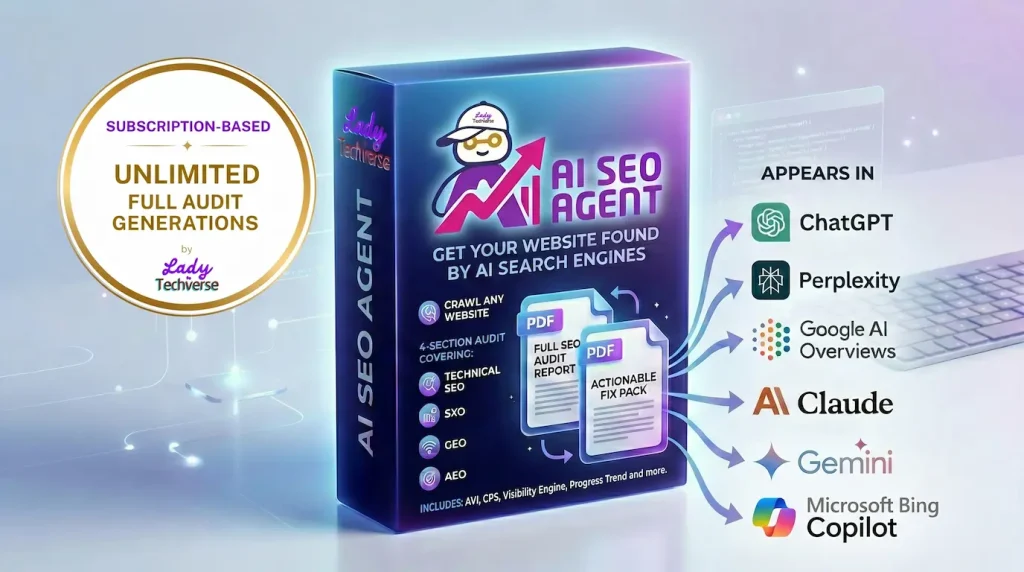
Picture where your AI Search Visibility Control Room exists when you use my LITV AI SEO Agent v2.0 that was designed for this – resolving Technical SEO, AEO, GEO and SXO on top of AVI, CPS, Visibility Engine, Progress Trend and more. The LITV AI SEO Agent v2.0 gives you a full picture of your AI search visibility, and being able to know exactly what is blocking you from being found, cited, and recommended – you can see it with your own eyes – across ChatGPT, Perplexity, Google AI Overviews, Claude, Gemini, and Bing Copilot.
Just in case you need to understand the purpose of this in your line of work as a B2B professional.
The Entity Consistency Audit
The entity consistency audit is a practical tool for identifying where your machine-readable authority signals are breaking down. It asks five questions across every public-facing property where your professional identity appears.
Is your name consistent? The same form of your name should appear identically across your website schema, your LinkedIn profile, your Google Business Profile, any Wikidata entry, and every third-party byline.
Is your professional title consistent? The schema markup on your website should use exactly the same role description as your LinkedIn headline and your author bios. Variations between “Fractional CMO,” “Marketing Consultant,” and “Chief Marketing Officer, Fractional” create entity ambiguity that reduces AI confidence in resolving your professional identity.
Is your employer entity consistent? If you operate under a named business, that entity should have its own schema markup at the organisation level, and your Person schema should reference it explicitly.
Is your geographic attribution consistent? For APAC practitioners, this matters more than it might elsewhere. “Singapore” should appear consistently in your entity signals, not alternating between “Southeast Asia,” “Asia-Pacific,” and being omitted entirely.
Is your domain of expertise stated consistently? Not necessarily in identical language across every property, but with enough conceptual overlap that an AI system can resolve the topical cluster you operate in without ambiguity.
Final Thoughts: The Bottom Line
Machine-readable authority is not a problem practitioners can solve when they have spare capacity. It is the current infrastructure layer that determines whether AI recommendation engines can find them at all.
For experienced practitioners in Singapore and across the APAC region, the urgency is higher than for counterparts in markets with stronger knowledge graph coverage. The structural disadvantage is real. The response is available: consistent entity architecture, deliberate structured data implementation, and a systematic citation programme through credible and independent sources.
The AI systems driving recommendation in 2026 are not going to become more lenient about unstructured evidence. They will become more reliant on machine-readable signals as confidence thresholds for practitioner recommendations tighten. Building that architecture now is not optional for practitioners who expect to be visible to the AI systems their clients are already using to find advisors.
If you want to understand what this looks like in practice, the full build story, including structured data implementation decisions and the APAC entity gap solutions is at the LITV builder story.
Frequently Asked Questions (FAQs)
Internal Articles
- Why B2B Marketing Attribution is Broken in the AI Search Era
- Marketing AI Readiness: How to Prepare Your B2B Team for Agentic AI
- Generative Engine Optimisation: How to Get Cited by AI in 2026
- Answer Engine Optimisation: How B2B Brands in Singapore Get Cited in AI Search in 2026
- Synthetic Content, AI Influencers and the Fight for Authenticity in Marketing
- What is Retrieval-Augmented Generation (RAG)? A Business Guide to AI that Knows Your Data
- I Built an AI SEO Agent to Fix the Visibility Gap in AI Search
- From Server to Sanctuary: Building for Agents, Living for Real?
- Personal Brand Authority in 2026: The One Asset AI Cannot Copy
- Vibe Coding is Rewriting Digital Services: What Agencies, SaaS, and Marketers Must Do Next
- AI Coding Tools 2026 – How to Choose the Right One for Your Workflow
- Why Internal Linking is the Most Underrated SEO Strategy You are Probably Ignoring
- The AI Productivity Paradox in 2025
- Agentic AI in 2025: Ripples that Signal the 2026 Workflow Tsunami
- How can CEOs use AI and Leadership to improve Crisis Communications in 2026?
- How Brands Build Human Trust in the Age of Agentic AI, Starting in 2026
- Digital Trust in 2025: Governance and Security Shaping the Next Economy
- Data Quality is the Power Move behind every winning AI Strategy in 2025
- Why more than 90% of AI Pilots Fail and How Hyper-Personalisation Wins
Sources Referenced
- Google Search Central — Introduction to Structured Data — Google — 2026
- Google Search Central — How Google Search Works — Google — 2026
- Google Search Central — Creating Helpful, Reliable, People-First Content (E-E-A-T) — Google — 2026
- Schema.org — Person Schema Type — Schema.org — 2026
- Schema.org — BlogPosting Schema Type — Schema.org — 2026
Visual Content Disclaimer: All images in this post are AI-generated.
Machine-Readable Authority: How AI Systems Decide Who to Recommend
#LadyinTechverse #DigitalSanctuary #DigitalTransformation #MarketingTransformation #MarTech #SchemaMarkupSEO #KnowledgeGraphOptimisation #B2BContentStrategy #machinereadableauthority


Leave a Reply