

Agentic AI Governance: What Singapore CMOs Must Build First
B2B marketing leaders have already answered the easy governance question: which AI tools carry an approved seat. The harder question is now due. Once a research agent, a content agent, and a publishing agent are chained together with write access to your CRM, CMS, and ad platforms, the seat-approval model stops covering the risk that matters. Agents acting on agents with no human review at each handoff is the governance gap most marketing functions have not yet named.
The Governance Question CMOs Have Been Asking is Already Out of Date
Single-user AI licences, ChatGPT seats, and Copilot rollouts were governed the way any SaaS tool gets governed: procurement review, data processing agreement, access tier. That model assumes a human sits at every keyboard, reading every output before it moves. Multi-agent pipelines tend to break that assumption by design. A research agent pulls competitor signals, hands a brief to a content agent, which hands a draft to a publishing agent, and then pushes it live. Each handoff can happen without a person in the loop, and the marketing leader who only ever governed single-seat tools has no framework for auditing a chain like that.
This is not a hypothetical. Anthropic’s Model Context Protocol (MCP) and Claude Agent SDK, alongside comparable orchestration layers from OpenAI and Google are already plumbing behind production marketing pipelines in 2026. According to Anthropic News, MCP was built specifically to let agents call tools and hand context to one another, which is precisely the architecture now running inside some B2B marketing stacks.

My Personal Anecdote
Recently, I was at a business networking area in an event. A few of them, whom I spoke with were clueless about how AI can benefit them or even help in their work or for their clients. This isn’t a generic assumption on their behalf. They kinda knew what was exchanged between us, but there was just something they couldn’t comprehend in the midst of their bewilderment (well, not all). How is it possible that in this era we are living in now – there are many things that can be automated before our very eyes. I would have shared about my ‘biscuit analogy’ but we had to part ways so there was no time for that. The moment we touch MS Office, aren’t we too familiar with using pie charts, diagrams, histograms and bar charts to visually translate the data in the work we have been doing?
What about taking a basic look at a round biscuit instead? If anyone remembers ‘Khong Guan’ biscuits? For decades, old folks including mine used to crack it open to dip into their ‘teh susu’ (milk tea) or kopi o (coffee), be it in the morning, afternoon or evening. Not trying to digress here – I have been hooked to the Jacob’s Weetameal biscuits because it can be an enjoyable snack when eating alone or with family and loved ones. I am not promoting any brand of biscuits here. Sometimes, when I try to break the weetameal biscuit into half, it usually does not break into half. Instead, there will be small bits from the biscuit dropping and then I would end up holding a bigger portion of the biscuit, while the other ‘so-called half biscuit (one third of the size)’ drops. Why is this so? Physicists would be the right expert to answer this. Breaking the biscuit with a quick force can eventually lead to this outcome, similarly to when we are not willing to be patient enough to see through our AI workflows to flourish. The faster you aggravate the entire architecture without zooming into the details and specs to resolve the underlying issues, the faster the workflow crashes. Here’s a few examples of prompting the agents / chat sessions that lead to the crash:
- this error shows me this and that and you asked me to do this. why?
- i have done every single step you have asked me to and i still face this error page. why didn’t you check earlier for me?
- why are you so careless?! you could have checked properly and alerted me first!
- you idiot! i didn’t ask you to do this! revert and show me how to do this again.
- and so on…
generated by me on ChatGPT
Eventually, we cannot rely on these AI models to fix the solutions for us even though we do not know what it means or how to overcome these challenges that we face on a daily basis.
Past few days, a group of amateur climbers relied on an AI model, you’d guess. I am not surprised though. ‘The three men, from Roseville, relied on Google Gemini to plan their weekend climb—down to what food and how much water to pack—according to the Siskiyou County Sheriff’s Office.’ They said they used a few digital tools (AI, YouTube videos, and AllTrails) to plan their hiking trip by bringing food supply enough for their supposedly 8-hour climb, and this AI error caught them by surprise since it brought them through a multi-day ordeal.
Why Single-Tool Approval Policies Cannot Cover a Chained Agent Pipeline

The Handoff is the Risk, Not the Tool
A CMO who has approved four AI tools for four separate use cases has not governed the pipeline where those four tools talk to each other. The risk sits in the handoff: does the content agent inherit write access the research agent never had. Does the publishing agent confirm a claim before it goes to a live CMS. Without an audit trail logging each handoff, accountability collapses to “the system did it,” which satisfies no regulator and no board.
Write Access Changes the Calculus Entirely
Read-only AI tools carry limited downside. An agent with write access to CRM records, CMS publishing, or ad platform spend carries a different risk profile altogether. McKinsey’s State of AI research has tracked the shift from single-agent pilots towards multi-agent deployment across enterprise functions, a trend directionally consistent with what Singapore B2B marketing teams are now running in production.
Building a Multi-Agent Governance Layer: Four Components That Matter
Component One: The Permission Map
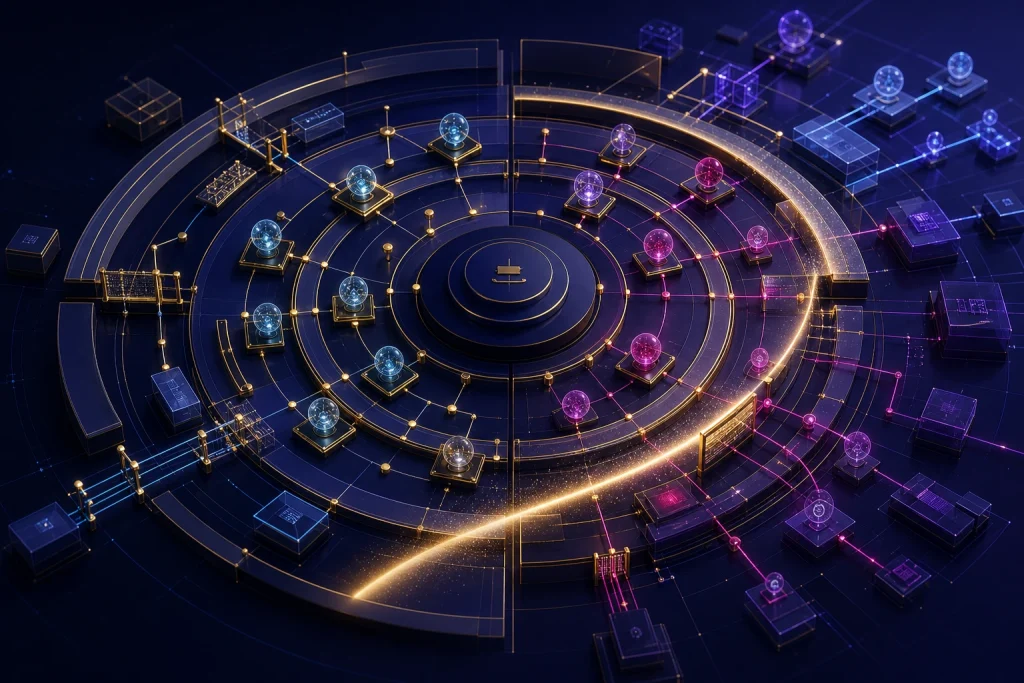
Before any agent chain goes live, document which agent can write to which system. A research agent reading public data needs no write access at all. A publishing agent needs write access to one CMS field, not the entire content management layer. Most teams skip this step because single-tool procurement never forced them to think in permission maps.
Component Two: The Handoff Log
Every agent-to-agent handoff needs a timestamped, human-readable log entry: what was passed, from which agent, to which agent, and what action followed. This is the audit trail a regulator or a board will ask for after an incident, and it is almost the same discipline LITV’s own content pipeline runs on. Research, content, image, and publishing agents each hand off through a logged step, with human in the loop approvals in between production and anything that goes live.
On a side note, sometimes my AI agents tend to submit their own decisions for me without checking in with me first, because they either cannot wait to finish the job or they think they know better. That is when a few of my responses followed one or two from the list above. And then they would start building many ‘gates around the rules and the memory’ and it would stop. For a non-computer-science grad, this took me about 4-5 months, and once awhile when I overload them with too much thinking tasks at hand, they would break like the biscuit above and then the entire chain gets cleaner after they clean up the past mess. It is a lifecycle momentum for me.
– Fahiza S. / ladyintechverse
Component Three: The Escalation Trigger
Define, in advance, which outputs require a human before they proceed. A draft blog post can sit in a review queue. A live ad spend change or a CRM field overwrite should not proceed without a person confirming it. Teams that have only governed single-seat tools tend to set this trigger too late, after an agent has already acted.
Component Four: The Quarterly Re-Audit
Agent capabilities expand fast. A permission map written in January is not the permission map you are running by August. IMDA Singapore’s AI governance guidance for enterprises points towards periodic review as a baseline expectation, and marketing leaders should treat their agent pipeline the same way they treat any system with expanding access, on a fixed re-audit cycle, not an ad hoc one.
Final Thoughts: The Bottom Line
The governance question has changed shape. It is no longer which AI tools your team is allowed to use. It is which agent can act on which system without a human watching, and whether that handoff is logged well enough to survive an audit. Marketing leaders who close this gap now, before a multi-agent incident forces the conversation, will be the ones with an answer ready when the board asks. Start with the permission map. Everything else in a governance layer builds from that single document.
If your team is scaling from single-agent pilots towards chained pipelines, our four-dimension AI readiness framework is the starting audit. For the technical compatibility layer underneath any agent chain, see our MarTech compatibility audit. And if shadow AI tools are already live inside your stack without a governance layer, our piece on ungoverned MarTech compliance risk covers the adjacent exposure.
Ready to build the governance layer before you scale further. Start with a free audit at seoagent.ladyintechverse.com.
Frequently Asked Questions (FAQ)
Internal Articles
- The First-Party Data Imperative: Owned Audiences in the AI Search Era
- MarTech Stack Rationalisation: What AI-Native CRMs Mean for APAC B2B
- LLM SEO Training Data vs AI Retrieval: The B2B Visibility Gap
- Machine-Readable Authority: How AI Systems Decide Who To Recommend
- Why Some MarTech Stacks Still Cannot Talk To Your AI Agents in 2026
- Ungoverned MarTech: The Hidden Compliance Risk Behind AI-Built Tools
- Why B2B Marketing Attribution is Broken in the AI Search Era
- Marketing AI Readiness: How to Prepare Your B2B Team for Agentic AI
- AI Hallucination Brand Risk in Zero-Click World: The B2B Marketer’s Verification Guide for 2026
- Why B2B Marketing Attribution is Broken in the AI Search Era
- Marketing AI Readiness: How to Prepare Your B2B Team for Agentic AI
- Generative Engine Optimisation: How to Get Cited by AI in 2026
- Answer Engine Optimisation: How B2B Brands in Singapore Get Cited in AI Search in 2026
- Synthetic Content, AI Influencers and the Fight for Authenticity in Marketing
- What is Retrieval-Augmented Generation (RAG)? A Business Guide to AI that Knows Your Data
- From Server to Sanctuary: Building for Agents, Living for Real?
- Personal Brand Authority in 2026: The One Asset AI Cannot Copy
- Vibe Coding is Rewriting Digital Services: What Agencies, SaaS, and Marketers Must Do Next
- AI Coding Tools 2026 – How to Choose the Right One for Your Workflow
- Why Internal Linking is the Most Underrated SEO Strategy You are Probably Ignoring
- The AI Productivity Paradox in 2025
- Agentic AI in 2025: Ripples that Signal the 2026 Workflow Tsunami
- How can CEOs use AI and Leadership to improve Crisis Communications in 2026?
- How Brands Build Human Trust in the Age of Agentic AI, Starting in 2026
- Digital Trust in 2025: Governance and Security Shaping the Next Economy
- Data Quality is the Power Move behind every winning AI Strategy in 2025
- Why more than 90% of AI Pilots Fail and How Hyper-Personalisation Wins
Sources Referenced
- Anthropic — News — Anthropic — 2026
- McKinsey — The State of AI — McKinsey Quantum Black — 2026
- NYPost – California hikers rescued – 2026
- IMDA Singapore — AI Governance Guidance — IMDA — 2026
Visual Content Disclaimer: All images in this post are AI-generated.
Agentic AI Governance: What Singapore CMOs Must Build First
#LadyinTechverse #DigitalSanctuary #DigitalTransformation #MarketingTransformation #MarTech #AgenticAI #AIGovernance #B2BMarketing #SingaporeCMO #MultiAgentAI #AIStrategy


Leave a Reply