

Three Retrieval Failure Modes That Explain Why Your AI Agent Cites the Wrong Source
An AI agent that cites the wrong source even when the correct document is already in its knowledge base, does not necessarily have a prompting problem. Instead, it has a retrieval problem more often, which can arise in three distinct ways: an old index overlooks recently added content; poor chunking separates an answer from the context needed to interpret it, or similarity search ranks superficially related passages above the authoritative source. Each failure requires a different remedy without a rewritten prompt.
Why “The Document Exists” is Not the Same as “The Agent Found It”
Marketing professionals deploying AI agents to answer buyer questions from owned content tend to make one assumption early: if the correct document is in the knowledge base, the agent will cite it. That assumption held while I was testing AI agent outputs against LadyinTechverse’s own content library during the build of the LITV AI SEO Agent v2.0. It did not survive the first week of testing.
My Personal Anecdote
It lives here when I was rebuilding LITV AI SEO Agent v2.0.
Building in public week 1 – 4 of ai seo agent v2.0
(Women-in-AI | BuildClub.ai)
(Women-in-AI | BuildClub.ai)
(Women-in-AI | BuildClub.ai)
full-stack product (Women-in-AI | BuildClub.ai)
Retrieval-augmented generation, the architecture behind most B2B AI agents answering from owned content, works in two stages. First, a retriever searches an indexed version of the knowledge base and returns the passages it judges most relevant to the query. Second, a language model generates an answer using only those retrieved passages as context. If the retriever returns the wrong passages, no amount of prompt engineering in the second stage recovers the correct answer, because the model was never shown the right material. My earlier explainer on what retrieval-augmented generation is covers the mechanism for teams new to the concept. This piece is for teams already running one, watching it cite the wrong thing, and needing to know which of the three failure points is responsible.
Failure Mode One: The Stale Index

A retrieval index is a snapshot, not a live view of the knowledge base. Most agent pipelines re-index on a schedule, whether nightly, weekly, or on manual trigger, rather than on every content change. Between index runs, an agent has no way to know a document exists. It will confidently cite an older, less accurate source because that is genuinely the best match available inside its indexed world.
This failure mode is the easiest to diagnose and the easiest to miss, because the symptom looks identical to a chunking or ranking problem from the outside: the agent cites a source that is technically wrong. The differentiator is timing. If the correct document was published or updated after the last scheduled index run, the current index is stale.
Here’s a quick fix: shorten the re-index interval for content that changes frequently, and add an event-triggered re-index on publish for anything treated as a primary source of truth, rather than relying on a batch schedule alone.
How to Confirm a Stale Index Before Assuming a Deeper Problem
Check the index’s last-updated timestamp against the correct document’s publish or last-modified date. If the document postdates the index, the diagnosis is closed. If the document predates the index and the agent still cited the wrong source, the failure sits downstream — in chunking or ranking, and a re-index will not fix it.
Failure Mode Two: Chunking That Splits Context From Its Source

Before a document enters a retrieval index, it is split into chunks, smaller passages sized to fit within the retriever’s context window. Chunking decisions, fixed character counts, sentence boundaries, or semantic breakpoints, determine what the retriever is actually searching over. A poorly chunked document can separate a claim from the qualifying detail that made it correct, or from the heading that gave it context, so that the retrieved passage reads as true and is a strong lexical match (keyword search) for many unrelated queries.
This is the failure mode most teams underestimate because the document itself reads perfectly in its published form. The damage happens silently during preprocessing. A well-written FAQ answer may work for a broad query, but fail for a specific one if chunking separates it from the term definition in the preceding paragraph.
Here’s a quick fix: chunk by semantic unit (a complete argument, a full Q&A pair, a bounded section) rather than by fixed token count, and test retrieval against the exact queries the agent is expected to field, not against a generic relevance benchmark.
Failure Mode Three: Similarity Search Favours a Superficial Match Over The Correct Source
Most retrieval systems rank candidate passages by vector similarity: how close a passage’s embedding sits to the query’s embedding in semantic space. This works well when the correct source and the query share both meaning. It breaks when a superficially related passage uses the same words as the query without answering it, and its embedding happens to be closer to the query than the correct specific source.
An AI agent asked about pricing structure, for example, can retrieve a passage that mentions pricing in passing, inside a page about a different product tier, ahead of the actual pricing page because the surrounding language in the wrong passage happens to echo the query’s phrasing more closely. The retriever is not wrong about similarity. It is answering a narrower question than the one being asked: which passage looks most like this query, not which passage actually answers it.
Here’s a quick fix: add a re-ranking step after initial retrieval, using a model trained specifically to score query-passage relevance rather than raw embedding proximity, and treat vector similarity as a candidate-generation filter, not a final ranking.
Why Naming the Failure Mode Changes the Fix
A generative AI engine, the mechanism underneath Google AI Mode and comparable agentic search products, blends training-data recall with live retrieval, a distinction I covered in more depth when unpacking Google AI Mode against classic AI Overviews. The same principle applies inside an owned agent pipeline: retrieval and generation are separable failure surfaces, and treating a retrieval fault as a generation fault wastes engineering time on the wrong layer. A team that responds to citation errors by rewriting the system prompt, when the actual fault is a stale index will see no improvement, and may conclude the agent architecture itself is unreliable. It is not that its unreliable; it is just not sufficiently diagnosed.

This distinction also matters for agentic AI B2B deployment more broadly, and for teams working across a wider EU B2B market where AI agent adoption inside marketing operations is accelerating on a similar timeline to Singapore and the U.S. Retrieval failure is not market-specific. The three mechanisms above apply to any RAG-based agent regardless of geography, though the operational discipline required to catch them, scheduled index audits, chunk-level testing, ranking evaluation is the same discipline I described when covering the training-data-versus-retrieval visibility gap for LLM SEO strategy at the global level.
Final Thoughts: The Bottom Line
A correct document sitting in a knowledge base guarantees nothing about whether an AI agent will find and cite it. Retrieval fails through a stale index, through chunking that strips context from a claim, or through similarity ranking that rewards surface-level exact keyword match over actual relevance. Diagnosing which of the three is responsible in that order, before touching a prompt is the difference between fixing a production agent and guessing at it. Teams running RAG-based agents against owned content should treat retrieval quality as an ongoing audit, not a one-time build step because content changes, chunking assumptions age, and ranking behaviour shifts as the knowledge base grows.
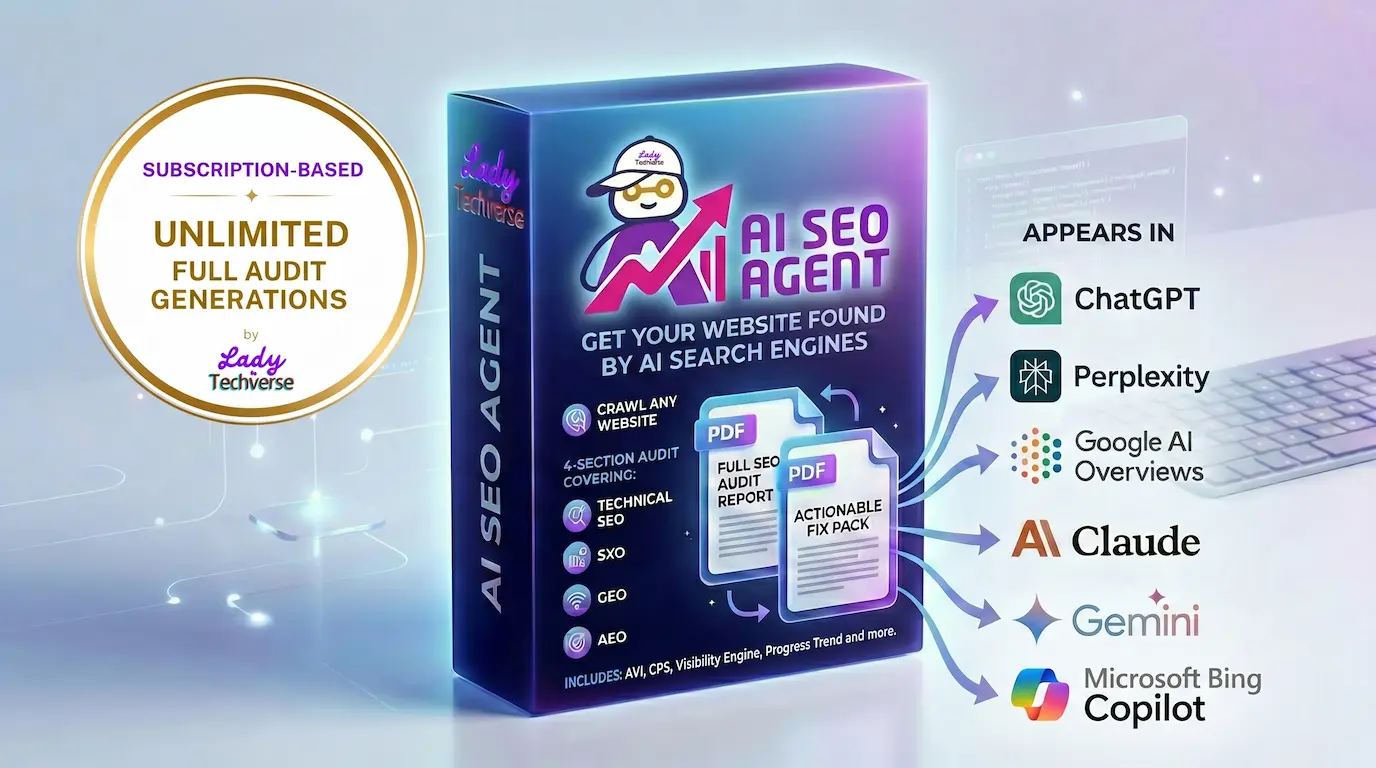
If your marketing team is deploying AI agents against owned content and has not run a retrieval audit since launch, that is the next concrete step, not another round of prompt tuning. The LITV AI SEO Agent applies structured evaluation to exactly this kind of AI visibility question. Explore it at seoagent.ladyintechverse.com.
Frequently Asked Questions
Why does an AI agent sometimes cite the wrong source even when the correct document exists in its knowledge base?
AI agents fail retrieval for three reasons: stale indexes that miss recent content, chunking that splits context away from its source, and similarity search that ranks superficially related text above the correct answer. Each failure mode needs a different fix, not a single prompt adjustment.
How often should a retrieval index be refreshed to avoid stale citations?
It depends on how frequently the underlying content changes. Fast-moving knowledge bases need event-triggered re-indexing on publish, not just a nightly or weekly batch job. Slower-changing reference material can tolerate a longer interval, but any primary source of truth should never sit more than a few days out of sync with the live index.
Can better chunking alone fix a retrieval accuracy problem?
Not alone. Chunking fixes context-splitting errors specifically. If the underlying issue is a stale index or weak similarity ranking, better chunking will not resolve either. Diagnose which failure mode is present first, using the index-timestamp check and a re-ranking test, before rebuilding the chunking strategy.
What is the difference between vector similarity search and re-ranking?
Vector similarity search scores how close a passage’s embedding sits to the query’s embedding, which is fast but purely geometric. Re-ranking applies a second model trained specifically to judge whether a passage actually answers the query, applied only to the shortlist similarity search returns. Using re-ranking as a second pass catches cases where a superficially similar passage outranks the genuinely correct one.
Is this retrieval failure problem specific to any particular AI platform or vendor?
No. The three failure modes, stale indexing, poor chunking, and weak similarity ranking, are structural properties of retrieval-augmented generation architecture itself, not defects specific to one vendor’s implementation. Any team running a RAG-based agent against an owned knowledge base, on any platform, needs to audit for all three.
How is this different from a hallucination problem?
A hallucination happens when a model generates a claim with no supporting source at all. A retrieval failure happens when a correct source exists but the retriever never surfaces it, so the model either cites the wrong document or, in some architectures, hallucinates around the gap. They require different fixes: hallucination needs output verification, retrieval failure needs index, chunking, and ranking audits.
Internal Articles
- No Laptop Needed: Publishing a WordPress Blog Entirely From a Phone
- AI Crawler Access Control: The GEO Decision CMOs Must Own
- Outcome-Based Pricing for Fractional Professionals in the AI Agent Era
- Why B2B Teams are Giving AI Search Its Own Budget Line in 2026
- Agentic AI Governance: What Singapore CMOs Must Build First
- The First-Party Data Imperative: Owned Audiences in the AI Search Era
- MarTech Stack Rationalisation: What AI-Native CRMs Mean for APAC B2B
- LLM SEO Training Data vs AI Retrieval: The B2B Visibility Gap
- Machine-Readable Authority: How AI Systems Decide Who To Recommend
- Why Some MarTech Stacks Still Cannot Talk To Your AI Agents in 2026
- Ungoverned MarTech: The Hidden Compliance Risk Behind AI-Built Tools
- Why B2B Marketing Attribution is Broken in the AI Search Era
- Marketing AI Readiness: How to Prepare Your B2B Team for Agentic AI
- AI Hallucination Brand Risk in Zero-Click World: The B2B Marketer’s Verification Guide for 2026
- Why B2B Marketing Attribution is Broken in the AI Search Era
- Marketing AI Readiness: How to Prepare Your B2B Team for Agentic AI
- Generative Engine Optimisation: How to Get Cited by AI in 2026
- Answer Engine Optimisation: How B2B Brands in Singapore Get Cited in AI Search in 2026
- Synthetic Content, AI Influencers and the Fight for Authenticity in Marketing
- What is Retrieval-Augmented Generation (RAG)? A Business Guide to AI that Knows Your Data
- I Built an AI SEO Agent to Fix the Visibility Gap in AI Search
- From Server to Sanctuary: Building for Agents, Living for Real?
- Personal Brand Authority in 2026: The One Asset AI Cannot Copy
- Vibe Coding is Rewriting Digital Services: What Agencies, SaaS, and Marketers Must Do Next
- AI Coding Tools 2026 – How to Choose the Right One for Your Workflow
- Why Internal Linking is the Most Underrated SEO Strategy You are Probably Ignoring
- The AI Productivity Paradox in 2025
- Agentic AI in 2025: Ripples that Signal the 2026 Workflow Tsunami
- How can CEOs use AI and Leadership to improve Crisis Communications in 2026?
- How Brands Build Human Trust in the Age of Agentic AI, Starting in 2026
- Digital Trust in 2025: Governance and Security Shaping the Next Economy
- Data Quality is the Power Move behind every winning AI Strategy in 2025
- Why more than 90% of AI Pilots Fail and How Hyper-Personalisation Wins
Sources Referenced
- Anthropic — Introducing Contextual Retrieval (2024)
- Pinecone — Chunking Strategies for LLM Applications
- Pinecone — Rerankers and Two-Stage Retrieval
- arXiv — Searching for Best Practices in Retrieval-Augmented Generation
Visual Content Disclaimer: All images in this post are AI-generated.
Three Retrieval Failure Modes Behind Wrong AI Agent Citations
#LadyinTechverse #DigitalSanctuary #DigitalTransformation #MarketingTransformation #MarTech #RAGFailures #AIAgentRetrieval #GenerativeEngineOptimisation #AIVisibility #B2BMartech #AgenticAI


Leave a Reply