

Claude Motion, Anthropic’s animation feature released in beta on 8 October 2026, turns a report, PDF or spreadsheet into a moving explainer in minutes. A quarterly results page becomes a chart walkthrough. A static onboarding PDF becomes a stepped product tour. A pricing one-pager becomes an animated side-by-side comparison. The build step just got faster, and the review step did not.
Two independent studies published in September 2026 give that question some evidence. A randomised experiment embedded in the ICML 2026 peer-review process found that allowing reviewers limited AI assistance made reviews 5.5 to 7% longer, with no evidence of an effect on paper scores or final decisions. A separate study of AI coding agent pull requests found that 61.4% of agent pull requests received no recorded human review, and that when a merged agent pull request needed a follow-up fix, the agent itself usually opened it. Neither study is about marketing. Both are about what happens when output gets cheap and checking does not.
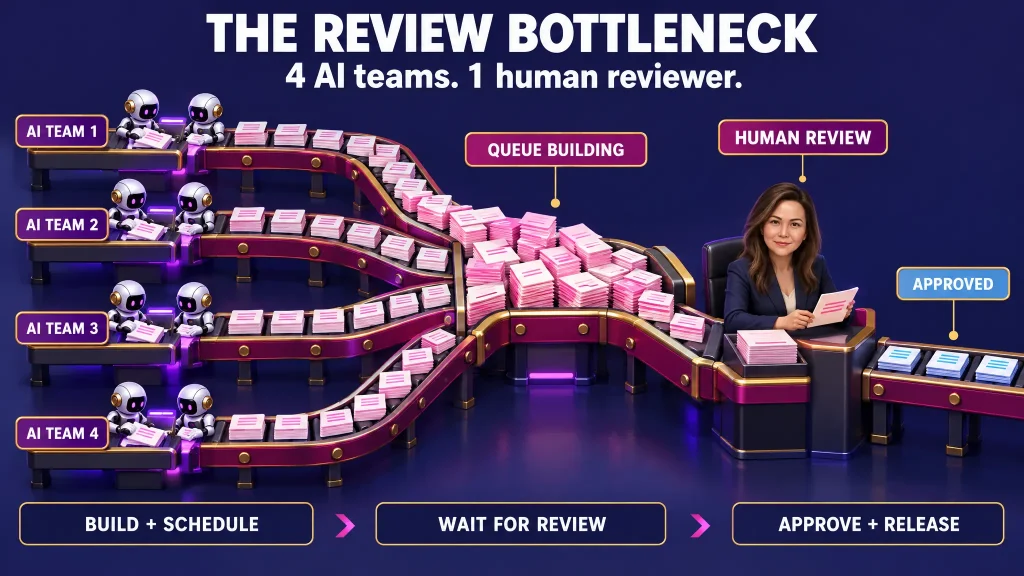
Apply that warning to marketing; a CMO who can generate an animated infographic from a dull PDF in minutes still has to check every number, every label and every claim inside it before it reaches a stakeholder, a client or a prospect. That verification step does not get faster because the file got easier to build. The bottleneck has not disappeared at all. In fact, it has grown to be increasingly complex due to the nature of the work packaged for a human review. Also, it has shifted from the concept and build steps to a human reviewer, and the last person who signs off the work or changes on it.
The Build Step Just Got Shorter

Claude Motion turns reports, charts, and product walkthroughs into short animated explainers. Anthropic says Claude writes each animation as code rather than using a video generation model, so there is no generated footage and no AI-generated people, and every word, number, and timing stays editable before you export into an MP4 file. For a marketing team used to briefing a designer, waiting on concept and mood boards, then to production days for a first draft, and iterating twice more before an animated asset is applicable and usable. A quarterly results walkthrough or a pricing comparison can now take an afternoon rather than a week. One practical limit matters before you plan around it. Motion is currently in beta on Claude Team and Enterprise plans only, so individual Pro and Max subscribers do not have it yet.
Claude Motion works directly from a source document. Feed it a quarterly report and it produces a moving chart walkthrough rather than a static slide. Feed it a product spec and it produces a stepped tour rather than a bullet-point PDF. For a marketing team used to briefing a designer, waiting days for a first draft, and iterating twice more before an animated asset is usable, this collapses a week of production into an afternoon.
This is a genuine capability. I have used enough of these build-speed tools, from drafting to layout to now animation, to know the pattern by now: whatever used to take days inside the production pipeline eventually takes minutes, and the team that adopts early gets a real head start on output volume. A stack that cannot talk to these tools yet is the first problem that’s time consuming and worth fixing.
From a Singapore practitioner’s view, and this is my own observation rather than measured data, solo and fractional marketing roles in the region were already stretching thin headcount across a lot of output. Agentic AI marketing content verification was already a stretched discipline before Claude Motion arrived. Adding a faster production layer on top of a verification process that was already thin is exactly the moment the bottleneck becomes visible.
But a faster build step changes what gets produced, not what gets checked frequently. An animated infographic carries the same numbers, the same comparisons and the same claims that a static one did. Nothing about the animation verifies that a chart’s axis is scaled correctly, that a comparison table is current, or that a claim about a competitor’s pricing is still true. The file moved, and the facts inside it still need a person to confirm them. Because Motion writes each animation as code, a wrong number can be corrected in seconds once someone spots it, which makes correction cheap, and spotting it is easy, however, anyone can miss it too as we are bombarded by too much information all the time.
Two Studies, One Warning: Output Outpaces Review
The ICML study is instructive precisely because it was not about marketing at all, and because its result is easy to read with various interpretations. The experiment ran inside the real ICML 2026 peer-review process, covering 24,661 papers and 17,886 reviewers. Reviewers were assigned to either a conservative policy that prohibited LLM use or a permissive policy that allowed limited assistance, and the researchers compared outcomes. They found no evidence that the policy changed paper scores, reviewer confidence, or final paper decisions, although reviews written under the permissive policy ran 5.5 to 7% longer. The study did not measure how well anyone verified anything, so it would be wrong to claim it proves a verification gap. AI assistance changed how much text was produced more visibly than it changed what was decided, and a longer review is not evidence of a more thoroughly checked one.

The pull request study is the sharper warning for anyone shipping AI-built assets. Across 891 repositories and five coding agents, 4.5% of merged agent pull requests drew a verified follow-up fix within 30 days, and agent merges carried 1.62 times the odds of a follow-up fix compared with human merges in the same repositories. Of 263 verified fixes on agent merges, 69.6% were opened by the same agent, 27.4% by a human, and 3.0% by a different agent. The authors also cite a figure that should make any marketing leader pause, which is that 61.4% of agent pull requests received no recorded human review. The honest picture is therefore not a human reviewer buried under an agent’s output. It is a review step that often does not happen at all, and a correction loop that the same tool is trusted to close.
The same relocation is already visible in B2B vendor evaluation, where AI agents now do comparison work marketing teams used to own, and the human sign-off step simply moves later in the process rather than disappearing. Marketing content built with tools like Claude Motion sits on the same curve. The build step compresses. The review step, done properly, does not.
What makes this an AI generated marketing content review bottleneck rather than a passing inconvenience is the compounding effect. One animated infographic a week was manageable under a loose review habit. Five a week, each produced in minutes rather than days, is a different workload entirely, and most marketing teams have not rebuilt their review process to match the new volume. The gap between what a team can now build and what it can now verify widens every time the build step gets another speed upgrade, and the pull request data suggests that, left unmanaged, the gap is filled by skipped review rather than faster review.
My Personal Anecdote
For me, this is not a loss as I have gotten around to building my own engines and adding layers of security from the ground up; from AI SEO Agent, an AI Market Desk Intelligence platform, and to video generation engines (internal use) for my platforms. And like what I meant from the above, the bottleneck is super real. I used to have very long review loop queue of work, and it kinda burn me out. That is no longer the case now, since I have adapted and consistently building, while updating my own rendering engines. All these started from a super boring workflow that I did not even want to start with, while pushing back on adopting AI work because of its incapable and unreliable outputs, as well as deliveries. It was through automation that I got the hang of managing agentic AI, its foundations, production layers and engines, and the tenacity to keep pushing the frontiers and capabilities of what my very own rendering engines could do. Well, of course it took me some weeks to experiment, review, change, and to spot the inconsistencies of its outputs across my social accounts.
Building from scratch is not an enjoyable job for some, but for me, it has been fruitful in shaping the outputs I want from my AI models, but not in a great imaginable way. It still requires a longer runway, but I am quite satisfied with what it has accomplished thus far. Knowing that this is the quality we may have to succumb to in the future, do not expect authentic originality, creativity and superb quality output from any AI model. I have given that up and because of that, I am learning to embrace its “unexpected quality outputs” like any humans with deep expertise.
What This Costs a Marketing Leader Who Skips the Check
Here is the practical risk. A team adopts Claude Motion, starts producing animated infographics at a volume that would have been impossible a month earlier, and the review discipline that worked for one static asset a week does not scale to five animated ones a week. Something gets missed, a stale statistic, a mislabelled axis, a comparison that quietly favours the wrong product, and it goes out under the brand’s name.

Readers are increasingly meeting marketing content through AI summaries before they ever reach the original asset, which means an error in an animated infographic can be restated, flattened and redistributed by a chatbot before anyone on the marketing team notices the original mistake. The review step was never just about catching an error before a human reader sees it. It is about catching it before an AI system amplifies it somewhere the brand cannot identify or correct.
For a fractional CMO or a solo marketer, this is not an argument against the tool. Claude Motion is worth adopting where your plan includes it, and resisting a genuine production speed-up on principle is its own kind of mistake. If your plan does not include it yet, the same verification habit applies to any tool that builds assets faster than you can read them. The argument is for building a verification step that scales with output volume rather than assuming the old and slower review habit will somehow catch up because the content now looks slightly polished. Three things make this workable in practice.
- A named reviewer per asset, not a shared assumption that someone will catch it.
- A short written checklist covering every number, label and comparison the animation contains, rather than a general read-through.
- A rule that no animated asset leaves the building without a dated sign-off against that checklist, so the verification step leaves the same kind of evidence trail the build step does.
None of this is expensive. It costs less than the tool did, and it is the only part of the pipeline that genuinely protects the brand once the build step is no longer the constraint.
Final Thoughts: The Bottom Line
Claude Motion and tools like this will keep compressing the concept and build steps. That is good news for marketing and content production teams that are under pressure to produce more with less. But the queue I have watched move through almost every efficiency tool, got deployed inside organisations does not really disappear when the concept and build steps shrink. It changes shape easily due to how its being produced, and it checks in with whoever signs off before publishing. Build the review discipline before the volume arrives, not after the first mistake goes out under the brand’s name.
Part of my experimental short animated videos were posted, where AI build speed meets marketing judgement, on TikTok at @marcomfintech, and on Instagram at @fsmarcomtech with upcoming short videos releasing through this month, November and till almost end of December, hopefully. 🤞
Ready to put a verification layer around your own AI-generated content? Start with LITV AI SEO Agent 2.0 and build the audit habit, whereby context tree evidence reveals your brand’s secret weapon.
Frequently Asked Questions (FAQs)
Does Claude Motion make marketing review faster?
Not on its own. Claude Motion speeds up building an animated explainer from a report or chart, but the numbers, labels, and claims inside it still need a person to check them. The build step shrinks, the verification step does not, so the queue moves to whoever signs off before publish. Because Motion writes each animation as code, corrections are quick once an error is found, but finding the error is requires manual work.
What is Claude Motion?
Claude Motion is an Anthropic feature released in beta on 8 October 2026 for Claude Team and Enterprise plans. It turns reports, charts, and product walkthroughs into short animated explainers that Claude writes as editable code, with no video generation model involved, and you can export the result as an MP4.
Which Claude plans include Claude Motion?
At launch, Claude Motion is in beta on Claude Team and Enterprise plans. Individual Pro and Max subscribers do not have it yet. Plan availability may change while the feature is in beta, so check Anthropic’s current announcement before you build a workflow around it.
Why does AI content review not speed up when generation does?
Generating content and verifying it are different kinds of work. In the ICML 2026 peer-review experiment, allowing limited AI assistance made reviews 5.5 to 7% longer with no evidence of a change in paper scores or final decisions. In a study of AI coding agent pull requests, 61.4% of agent pull requests received no recorded human review. Both point to the same risk. Output gets cheaper, and the checking either stays manual or quietly gets skipped.
Who should check an AI generated animated infographic before it publishes?
Whoever owns the final claim, usually the marketing leader or the fractional CMO on the account, not the tool. Every number, label and comparison in the animation needs a named human sign-off before the asset leaves the building.
Does faster content production reduce marketing headcount need?
Not for verification work. Faster production tools compress the build step, which can reduce drafting hours, but the judgement step, checking accuracy and framing, still needs a person with context on the account. That role does not shrink with the tool.
How should a marketing team adopt Claude Motion safely?
Treat the animated file as a first draft, not a final asset. Build a short verification checklist, covering each number, label and claim, and assign one named reviewer per asset before it goes to a client or publishes externally.
Internal Articles
- Robots.txt Allows ChatGPT. The Rate Limiter Still Says No.
- AI Agent Identity and Liability in the Future of Software
- PHP2Shell: What AI Changed for WordPress
- Own the Machine, Not the Model
- MCP went neutral. Five vendors Still Wrote the Rules.
- Why APAC B2B Senders are Losing the Inbox Placement Race
- 71% of AI Agent Traffic Hides Inside Your “Chrome” Analytics
- 60% Read AI Summaries. Your Content Answers One Question.
- WordPress Core Web Vitals: Why the Paid Audit is Losing its Case
- Three Retrieval Failure Modes Behind Wrong AI Agent Citations
- No Laptop Needed: Publishing a WordPress Blog Entirely From a Phone
- AI Crawler Access Control: The GEO Decision CMOs Must Own
- Outcome-Based Pricing for Fractional Professionals in the AI Agent Era
- Why B2B Teams are Giving AI Search Its Own Budget Line in 2026
- Agentic AI Governance: What Singapore CMOs Must Build First
- The First-Party Data Imperative: Owned Audiences in the AI Search Era
- MarTech Stack Rationalisation: What AI-Native CRMs Mean for APAC B2B
- LLM SEO Training Data vs AI Retrieval: The B2B Visibility Gap
- Machine-Readable Authority: How AI Systems Decide Who To Recommend
- Why Some MarTech Stacks Still Cannot Talk To Your AI Agents in 2026
- Ungoverned MarTech: The Hidden Compliance Risk Behind AI-Built Tools
- Marketing AI Readiness: How to Prepare Your B2B Team for Agentic AI
- AI Hallucination Brand Risk in Zero-Click World: The B2B Marketer’s Verification Guide for 2026
- Why B2B Marketing Attribution is Broken in the AI Search Era
- Generative Engine Optimisation: How to Get Cited by AI in 2026
- Answer Engine Optimisation: How B2B Brands in Singapore Get Cited in AI Search in 2026
- Synthetic Content, AI Influencers and the Fight for Authenticity in Marketing
- What is Retrieval-Augmented Generation (RAG)? A Business Guide to AI that Knows Your Data
- I Built an AI SEO Agent to Fix the Visibility Gap in AI Search
- From Server to Sanctuary: Building for Agents, Living for Real?
- Personal Brand Authority in 2026: The One Asset AI Cannot Copy
- Vibe Coding is Rewriting Digital Services: What Agencies, SaaS, and Marketers Must Do Next
- AI Coding Tools 2026 – How to Choose the Right One for Your Workflow
- Why Internal Linking is the Most Underrated SEO Strategy You are Probably Ignoring
- How can CEOs use AI and Leadership to improve Crisis Communications in 2026?
- The AI Productivity Paradox in 2025
- Agentic AI in 2025: Ripples that Signal the 2026 Workflow Tsunami
- How can CEOs use AI and Leadership to improve Crisis Communications in 2026?
- How Brands Build Human Trust in the Age of Agentic AI, Starting in 2026
- Digital Trust in 2025: Governance and Security Shaping the Next Economy
- Data Quality is the Power Move behind every winning AI Strategy in 2025
- AI Scams are Surging Fast | 2025
Sources Referenced
- Anthropic — Build live dashboards and animate explainers with Claude (Claude Motion beta launch) — Oct 2026
- arXiv — Use and Effects of LLMs in Peer Review: A Randomized Experiment and Survey at ICML 2026 — Sep 2026
- arXiv — Who Finishes the Job? A Study of Follow-Up Fixes and Commit Authorship on AI Coding Agent Pull Requests — Sep 2026
Visual Content Disclaimer: All images in this post are AI-generated.
Claude Motion Builds Fast. Marketing Review Still Takes Days
#LadyinTechverse #DigitalSanctuary #MarketingTransformation #MarTech #ClaudeMotion #AIContentReview #AgenticAI #MarketingVerification


Leave a Reply